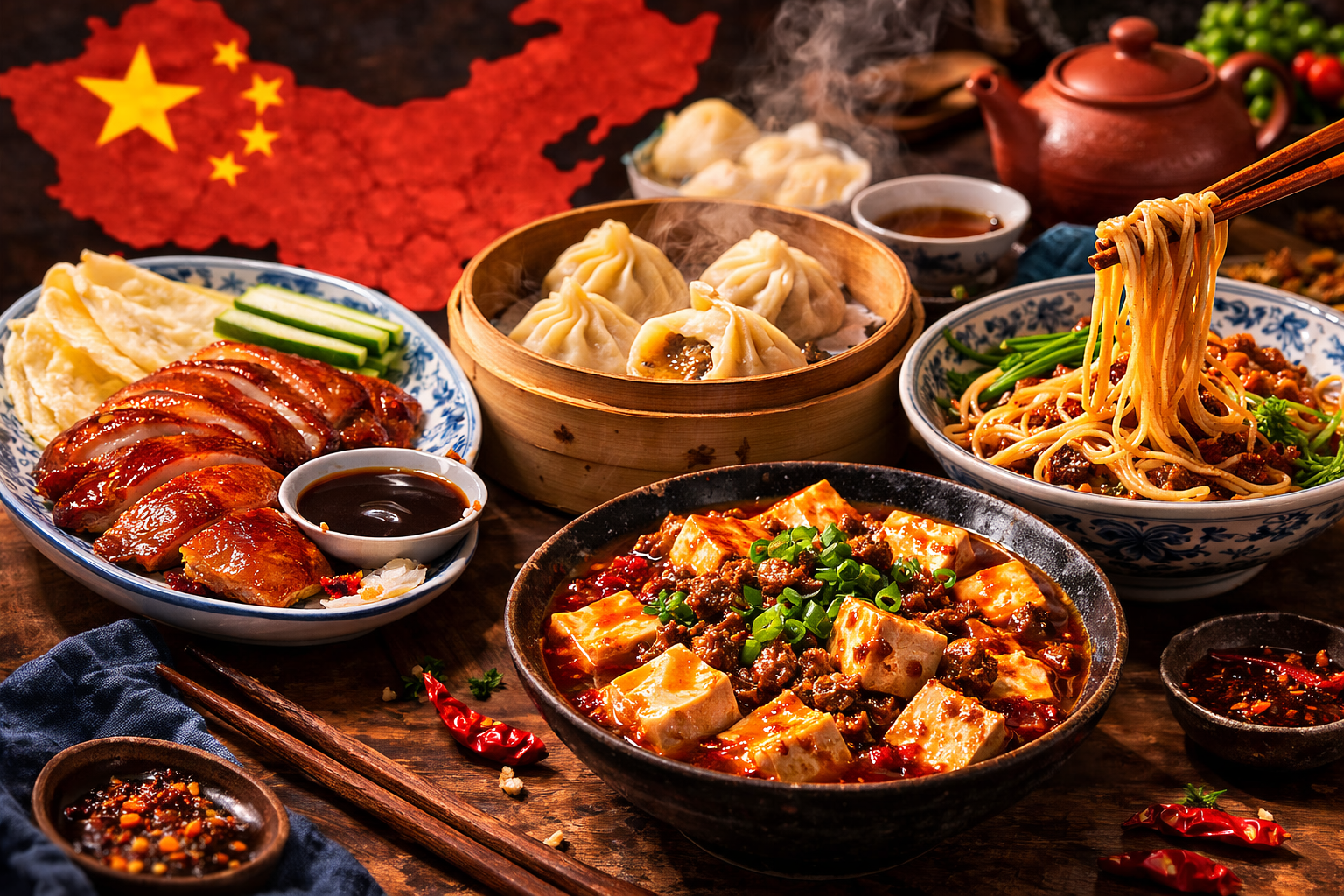
Sugerowany rozmiar: 1200×630px
Best Food to Eat in China: Classic Dishes From Every Region
Forget everything you think you know about Chinese food. There are no fortune cookies, no General Tso’s chicken, no orange-glazed anything. Real Chinese cuisine is eight radically different regional traditions spanning a country the size of Europe — from the mouth-numbing fire of Sichuan to the delicate artistry of Cantonese dim sum to street food in Xi’an that has no equivalent anywhere on Earth.
China has the oldest continuous culinary tradition on the planet. The concept of balancing flavors, textures, and temperatures in a single meal was codified here thousands of years ago. The eight officially recognized regional cuisines (八大菜系) are so different from each other that traveling from Guangzhou to Chengdu to Beijing is as dramatic a food shift as traveling from Naples to Stockholm to Istanbul. This guide covers all eight traditions, 20 essential dishes, the best food cities, street food culture, prices, and the dining etiquette that will earn you respect at any Chinese table.
China is part of our Best Food in Asia guide covering nine top food destinations across the continent.
Cantonese Cuisine: Dim Sum, Roast Meats and the World’s Most Refined Chinese Food
Cantonese food (from Guangdong province and Hong Kong) is the Chinese cuisine most Westerners have encountered — but the version served abroad is a pale shadow of the original. Real Cantonese cooking is defined by one obsession: preserving the natural flavor of the ingredient. Sauces are light, cooking times are precise, and freshness is non-negotiable. A Cantonese chef who overcooks a shrimp or over-sauces a fish has committed a professional sin.
Dim sum — the art of small bites
Dim sum (点心, “touch the heart”) is a Cantonese tradition of small dishes served alongside tea, typically for brunch. The classics: har gow (translucent shrimp dumplings — the skin should be thin enough to see the pink shrimp through it), siu mai (open-topped pork-and-shrimp dumplings), char siu bao (fluffy steamed BBQ pork buns), cheung fun (silky rice noodle rolls filled with shrimp, beef, or char siu), lo mai gai (sticky rice in lotus leaf), and dan tat (custard egg tarts with flaky pastry). A proper dim sum session involves ordering 8–15 dishes from a rolling cart or a checklist menu, drinking infinite tea (chrysanthemum or pu-erh), and spending 2 hours at the table. HK$100–250 ($13–32 USD) per person in Hong Kong. ¥60–150 ($8–21 USD) in Guangzhou.
Cantonese roast meats (siu mei)
Every Cantonese neighborhood has a roast meat shop with lacquered ducks, glistening pork bellies, and red char siu hanging in the window. Char siu (叉烧) — Cantonese BBQ pork, glazed with honey, five-spice, and red fermented bean curd until caramelized and slightly charred. Eaten over rice (char siu fan) or in buns. Siu yuk — roast pork belly with skin so crispy it shatters like glass. Siu ngo — roast goose (more flavorful than duck, a Hong Kong specialty — Yung Kee in Central has been the benchmark since 1942). A plate of char siu rice: HK$45–70 ($6–9 USD) / ¥25–50 ($3.50–7 USD) on the mainland.
Wonton noodle soup
A Hong Kong icon: thin, alkaline egg noodles in a clear shrimp-shell broth, topped with plump shrimp-and-pork wontons wrapped so thin the filling shows through. The noodle texture must be springy (dan), not soft. Mak’s Noodle and Tsim Chai Kee in Hong Kong have refined this to an art form. HK$40–60 ($5–8 USD). On the mainland, look for Cantonese wonton shops in any southern city — the broth alone is worth the trip.
“Yum cha” (饮茶) literally means “drink tea” — it’s the Cantonese term for the dim sum meal. When someone pours you tea, tap two fingers on the table twice as a thank-you (a tradition from Emperor Qianlong’s era). When the teapot is empty, leave the lid ajar — the waiter will know to refill it. Never pour for yourself before pouring for others at the table.
Sichuan Cuisine: The Most Addictive Flavor in the World
Sichuan food (from Chengdu and Chongqing in southwestern China) is the cuisine that ruins your ability to eat bland food ever again. The signature flavor is mala (麻辣) — a combination of “ma” (the tingling numbness from Sichuan peppercorn) and “la” (chili heat). The first time you experience real mala, your lips go numb, your tongue buzzes, sweat beads on your forehead, and you can’t stop eating. It’s chemically addictive in the best possible way.
Sichuan hotpot (huoguo)
A bubbling cauldron of chili oil, Sichuan peppercorns, and dozens of dried spices sits in the center of the table. You order raw ingredients — thinly sliced beef and lamb, fresh vegetables, tofu, mushrooms, noodles, tripe, brain, whatever you’re brave enough to try — and cook them in the boiling broth yourself. The dipping sauce station lets you build your own mix (sesame oil, garlic, cilantro, oyster sauce). Chongqing hotpot is considered more intense than Chengdu’s version — hotter, oilier, and with a wider range of offal. A hotpot dinner for two: ¥100–200 ($14–28 USD). Haidilao is the famous chain (with free manicures while you wait), but local joints in Chengdu’s Yulin neighborhood are more authentic.
Mapo tofu (麻婆豆腐)
Soft silken tofu swimming in a fiery sauce of chili oil, fermented broad bean paste (doubanjiang — the “soul of Sichuan cooking”), Sichuan peppercorn, and ground pork. The original version at Chen Mapo Tofu in Chengdu (open since 1862) is leagues beyond any version abroad — the mala numbness hits first, then the chili heat, then the deep umami of the fermented bean paste. ¥25–50 ($3.50–7 USD). It’s also one of China’s best vegetarian dishes when made without pork.
Kung pao chicken (gong bao ji ding)
Diced chicken wok-fried with dried red chilies, Sichuan peppercorn, roasted peanuts, and scallions in a sauce of soy, vinegar, and sugar. The real version is drier, spicier, and more complex than the goopy, sweet Western adaptation. The dried chilies aren’t meant to be eaten whole (though some brave souls do) — they flavor the oil. The peanuts add crunch and fat. It’s a perfectly balanced dish: spicy, sour, sweet, savory, and nutty. ¥30–60 ($4–8 USD).
Dan dan noodles (担担面)
Thin wheat noodles in a sauce of chili oil, Sichuan pepper, sesame paste, preserved vegetables (ya cai), and minced pork. The original Chengdu version is almost dry — just enough sauce to coat the noodles — and served in a small bowl, unlike the soupy versions common outside Sichuan. The balance of nutty sesame, numbing pepper, and chili heat is what makes it extraordinary. ¥12–25 ($1.70–3.50 USD) at street level.
Chongqing spicy chicken (la zi ji)
A mountain of deep-fried chicken pieces buried under an avalanche of dried red chilies and Sichuan peppercorns. The chicken-to-chili ratio is roughly 1:3 — you dig through the chilies to find the chicken. It looks terrifying and tastes incredible. The chilies are toasted in the wok and flavor the oil that permeates the chicken. A Chongqing specialty that Chengdu has adopted enthusiastically. ¥40–80 ($5.50–11 USD).
The numbness from Sichuan peppercorn is not pain — it’s a physical vibration on your lips and tongue caused by hydroxy-alpha sanshool, a compound that activates touch receptors. It’s harmless but intense the first time. Start with mapo tofu (moderate mala), then graduate to hotpot. Keep plain rice, beer, or sweet soy milk nearby — they help more than water. After a few days of Sichuan food, your tolerance will increase dramatically, and you’ll start craving the numbness.
Beijing and Northern Chinese Food: Peking Duck, Dumplings and Wheat
Northern Chinese cuisine (Beijing, Shandong, Dongbei/Manchuria) is built on wheat, not rice. Noodles, dumplings, steamed buns, and pancakes are the staples. The flavors are more savory and rustic than the south — hearty, warming, and designed for cold winters. Beijing’s food culture is a mix of imperial court cuisine, Muslim Hui influences, and the straightforward, big-portioned cooking of the northeastern provinces.
Peking duck (北京烤鸭)
China’s most famous dish and Beijing’s crowning glory. A whole duck is inflated with air to separate the skin from the fat, glazed with maltose syrup, and roasted in a fruitwood-fired oven until the skin is lacquered mahogany and shatteringly crispy. The duck is carved tableside by a chef who separates the prized skin from the meat. You eat it in thin pancakes (bing) with scallion, cucumber, and hoisin or sweet bean sauce. The first course is crispy skin dipped in sugar. The bones go into a soup — nothing is wasted.
The two great rival traditions: Da Dong (modern, lean, crispy-skin focused — their “superb duck” has the thinnest skin in Beijing) and Quanjude (the oldest, since 1864, more traditional and fattier). Siji Minfu is the best value for quality. A whole duck: ¥198–398 ($28–56 USD) depending on the restaurant. Half duck available at most places. Reserve ahead at popular restaurants — Peking duck takes 45+ minutes to prepare.
Zhajiangmian — Beijing’s noodle dish
Thick, hand-pulled wheat noodles topped with a savory paste of fermented soybean sauce (zhajiang) fried with diced pork, served with an array of fresh toppings — julienned cucumber, bean sprouts, edamame, radish — that you mix in yourself. A humble, deeply satisfying bowl that Beijingers eat year-round. ¥20–40 ($2.80–5.50 USD).
Jianbing — China’s greatest breakfast
A thin, crispy mung bean crepe cooked on a round griddle, spread with egg, brushed with sweet bean sauce and chili, topped with cilantro, scallions, and a crunchy fried wonton cracker, then folded into a portable package. It’s the breakfast of 20 million Beijingers — made by street vendors at every intersection from 6–10 AM. Watching a skilled jianbing maker is mesmerizing. ¥8–15 ($1.10–2 USD). Possibly the best breakfast on Earth for under $2.
Lamb and Muslim food in Beijing
Beijing has a large Hui (Chinese Muslim) community, and their food is everywhere. Mongolian lamb hotpot (shuàn yángròu) — paper-thin slices of lamb swished in a copper chimney pot of clear, mildly seasoned broth, then dipped in sesame paste with fermented tofu and chili oil. Lamb skewers (yang rou chuan’r) — cumin-and-chili-dusted lamb on metal skewers, grilled over charcoal. A ubiquitous Beijing street snack, best eaten at night market stalls. ¥3–5 per skewer.
Shanghai and Eastern Chinese Cuisine: Sweet, Delicate and Soupy
Shanghainese cooking (and the broader Jiangsu-Zhejiang region) favors sweetness, subtlety, and complex braising techniques. Soy sauce is darker and sweeter. Sugar appears in unexpected places. The cooking is more refined and less aggressive than Sichuan or northern food — this is the cuisine of China’s wealthy merchant class and historic literary culture.
Xiaolongbao — Shanghai’s soup dumplings
The most famous Shanghai food export: thin-skinned dumplings filled with pork (and sometimes crab) and a pocket of rich, gelatinized broth that liquefies when steamed. The technique: place the dumpling on a spoon, bite a small hole in the skin, carefully sip out the hot soup, then eat the rest in one bite. Burning the roof of your mouth at least once is a rite of passage. Din Tai Fung (Taiwanese chain, but with excellent Shanghai branches) and Jia Jia Tang Bao on Huanghe Road are the standard-bearers. ¥30–60 ($4–8 USD) for a steamer of 8–10.
Dongpo pork (东坡肉)
A Hangzhou (Zhejiang) classic named after the poet Su Dongpo: thick cubes of pork belly braised for hours in Shaoxing wine, soy sauce, sugar, and ginger until the fat renders to a trembling, gelatinous, melt-on-your-tongue texture while the lean meat stays tender. The sauce is dark, glossy, and sweet-savory. It’s one of the most decadent pork dishes in the world. Served in the clay pot it was cooked in. ¥40–80 ($5.50–11 USD).
Hairy crab season (September–November)
The Chinese mitten crab (大闸蟹, da zha xie) from Yangcheng Lake near Suzhou is one of China’s most prized seasonal ingredients. Steamed whole, eaten with ginger-vinegar dip, the female crabs are prized for their rich, golden roe and the males for their creamy white milt. Crab season is a cultural event — restaurants create special hairy crab menus, and prices for genuine Yangcheng Lake crabs run ¥100–300+ per crab. It’s a once-a-year obsession that illustrates China’s deep connection between food and season.
Red-braised pork (hong shao rou)
The comfort food of eastern China (and reportedly Mao Zedong’s favorite dish): pork belly cubes braised in soy sauce, sugar, Shaoxing wine, star anise, and cinnamon until deeply caramelized and falling apart. Sweeter than the northern version, darker, and more aromatic. Every family has their recipe. The restaurant version at any Shanghainese home-cooking place (本帮菜, benbangcai) is excellent. ¥30–60 ($4–8 USD).
Xi’an: The Greatest Street Food City You’ve Never Heard Of
Xi’an (home of the Terracotta Warriors) was the eastern terminus of the Silk Road, and its food reflects centuries of Central Asian influence. The Muslim Quarter (回民街, Huimin Jie) is one of the most exciting food streets in the world — a chaotic, aromatic, smoke-filled corridor of grills, noodle-pulling stations, and bread ovens that runs for about a kilometer.
Roujiamo — the Chinese hamburger
A round, crispy-outside, layered flatbread (mo) split open and stuffed with slow-braised, cumin-spiced pork or lamb that’s been chopped with a cleaver until shredded. The bread is baked in a clay oven and has a flaky, almost puff-pastry texture. The meat, braised in a soy-and-spice broth for hours, is rich, fatty, and intensely seasoned. It’s a 2,000-year-old dish that predates the Western hamburger by about 1,800 years. ¥8–15 ($1.10–2 USD).
Biang biang noodles
Impossibly wide, hand-pulled belt noodles — each one as wide as your hand — slapped against the counter as they’re stretched (the “biang biang” sound). Tossed with chili oil, vinegar, garlic, and sautéed vegetables, with a sizzle of hot oil poured over the top at the table. The noodle is chewy, substantial, and absorbs sauce like a sponge. The Chinese character for “biang” is so complex (57 strokes) that it doesn’t exist in any standard dictionary. ¥12–25 ($1.70–3.50 USD).
Yang rou pao mo — lamb and bread soup
A bowl of slow-simmered lamb broth served with flat bread (mo) that you tear into tiny pieces yourself — this active participation is the point, and how finely you tear the bread is a matter of local pride. The torn bread soaks up the rich, mutton-scented broth, and the bowl is filled with lamb, glass noodles, and pickled garlic. A Muslim Quarter signature and one of Xi’an’s most soul-warming dishes. ¥25–50 ($3.50–7 USD).
Yunnan: China’s Hidden Food Paradise
Yunnan province in China’s far southwest is the country’s most biodiverse region — tropical forests, high-altitude plateaus, and 25 ethnic minority groups whose cuisines have remained distinct for centuries. The food uses more fresh herbs, mushrooms, flowers, and fermented ingredients than any other Chinese cuisine. It’s lighter, more Southeast Asian in spirit, and wildly unique.
Crossing-the-bridge noodles (过桥米线)
Yunnan’s most famous dish: a bowl of piping-hot chicken broth topped with a layer of oil to retain heat, served alongside plates of raw ingredients — paper-thin sliced chicken, pork liver, quail eggs, tofu skin, chrysanthemum leaves, fresh rice noodles. You add them to the broth one by one; the heat cooks them in seconds. The name comes from a legend about a wife who crossed a bridge daily to deliver noodle soup to her studying husband. ¥20–50 ($2.80–7 USD).
Wild mushroom season (June–September)
Yunnan has more edible wild mushroom species than almost anywhere on Earth — matsutake, porcini, chanterelles, and dozens of varieties with no English names. During mushroom season, every restaurant in Kunming serves wild mushroom hotpot, stir-fried mushroom platters, and mushroom soups. The experience is earthy, primal, and entirely unique to Yunnan. Mushroom hotpot: ¥80–200 ($11–28 USD). Warning: some wild mushrooms can cause hallucinations if undercooked — this is so common that there’s a local meme culture about it.
Erkuai — Yunnan rice cakes
Thick, chewy rice cakes (unique to Yunnan) stir-fried with ham, chili, and vegetables, or grilled and eaten with rose petal jam and fermented bean paste. Unlike any rice cake you’ve had elsewhere — the texture is denser and chewier, almost like mochi crossed with pasta.
Chinese Street Food: Breakfast, Night Markets and Snacks Between Meals
Chinese street food is a world of its own — and it’s where most Chinese people actually eat much of the time. Breakfast culture alone could fill a book: congee (rice porridge) with a dozen possible toppings, jianbing crepes, youtiao (fried dough sticks), steamed buns in bamboo steamers, and savory soy milk. Night markets in every city offer an entirely different menu: skewers, stinky tofu, grilled squid, cold noodles, and regional specialties.
The street food essentials
Cong you bing — flaky scallion pancakes, fried golden and crispy. ¥3–8. Stinky tofu (chou doufu) — fermented tofu deep-fried until crispy outside, served with chili sauce. The smell is intense; the taste is mild, slightly funky, and addictive. A Changsha and Taiwan specialty, found everywhere. ¥5–15. Grilled lamb skewers (yang rou chuan’r) — dusted with cumin and chili. ¥3–5 per skewer. Tanghulu — candied fruit (usually hawthorn berries) on a stick, glazed in crackly sugar. Beijing’s signature sweet snack. ¥5–10.
Baozi — steamed stuffed buns with fillings from pork (the standard) to vegetables, mushroom, and red bean paste. Breakfast staple. ¥1–3 per bun. Congee (zhou) — rice porridge served with pickles, peanuts, and preserved eggs. The ultimate comfort breakfast. ¥5–15. Egg waffle (ji dan zai) — a Hong Kong invention: batter cooked in a bubble-shaped waffle iron, creating crispy-edged, pillowy-centered spheres. ¥10–20.
Most street food vendors in China use WeChat Pay or Alipay — cash is increasingly rare. International tourists can now link international credit cards to Alipay (via the “Tour Pass” feature) to pay at street stalls. Without mobile payment, you may need to carry small bills (¥5, ¥10). Some vendors in tourist areas still accept cash, but in smaller cities, mobile payment is often the only option.
The Great Chinese Noodle Traditions
China’s noodle diversity makes Italy’s pasta culture look like a single menu. Every province, often every city, has its own noodle tradition — different widths, different techniques, different sauces, different broths.
Lanzhou hand-pulled beef noodles (兰州拉面)
The most popular noodle dish in China: a clear beef bone broth, hand-pulled wheat noodles in your choice of width (from hair-thin to belt-wide), topped with sliced beef, chili oil, cilantro, and radish. In Lanzhou itself, this is a breakfast food — shops open at 6 AM and close by 2 PM. The noodle-pulling technique (拉面, lamian) involves stretching and folding the dough dozens of times until the desired thickness is achieved. Lanzhou lamian shops exist in every city in China — look for the Hui (Muslim) halal signs. ¥8–18 ($1.10–2.50 USD).
Chongqing xiao mian — small noodles, big flavor
Chongqing’s answer to Sichuan dan dan noodles: thin wheat noodles in a bowl of chili oil, Sichuan pepper, soy sauce, sesame paste, peanuts, and preserved vegetables. Spicier and more aggressively seasoned than dan dan mian. A breakfast-and-lunch staple in Chongqing. ¥8–15 ($1.10–2 USD).
Knife-cut noodles (dao xiao mian) — Shanxi province
A lump of dough is held against the chef’s forearm, and thin shavings are sliced directly into boiling water with a curved knife — the noodles fly through the air into the pot. The result is thick, irregular, chewy noodles with one smooth side and one rough side that grips sauce differently. Served in a thick lamb or tomato-egg broth. A Shanxi specialty that’s spreading across China. ¥15–30 ($2–4 USD).
Dumplings: China’s Most Universal Food
Dumplings (jiaozi, 饺子) are eaten across all of China, but the northern tradition — where jiaozi are a staple rather than a snack — is the heartland. During Chinese New Year, families make hundreds of jiaozi together.
Boiled dumplings (shui jiao) — the classic: thin wheat skin filled with pork-and-cabbage, pork-and-chive, or lamb-and-onion, boiled and dipped in vinegar-soy sauce with chili oil. Pan-fried dumplings (guo tie / potstickers) — fried on one side until crispy-bottomed, steamed to cook through. Steamed dumplings — lighter, more delicate, especially the Cantonese har gow. Soup dumplings (xiaolongbao) — Shanghai’s pride (covered above).
In Dalian, Xi’an, and Harbin, dumpling restaurants with 50+ filling options are common. A plate of 15–20 jiaozi: ¥15–35 ($2–5 USD). The best way to experience Chinese dumplings is a dedicated dumpling dinner where you order 4–5 types and compare.
Chinese dumplings live or die by their dipping sauce. The standard mix: Chinkiang black vinegar (镇江香醋) + a few drops of soy sauce + chili oil + sliced garlic. The Chinkiang vinegar is the crucial ingredient — it’s darker, sweeter, and more complex than Western vinegar. Every dumpling restaurant has a vinegar station. Experiment until you find your perfect ratio.
Tea Culture and Chinese Drinks
China is the birthplace of tea, and the culture runs far deeper than a bag in a mug. The major categories: green tea (Longjing from Hangzhou is the most prized — sweet, grassy, nutty), oolong (partially oxidized, floral — Tie Guan Yin from Fujian), pu-erh (aged, fermented, earthy — from Yunnan, aged cakes can cost thousands), white tea (minimal processing, delicate), and jasmine tea (green tea scented with jasmine flowers — Beijing’s standard restaurant tea).
In Fujian and Guangdong, gongfu cha (功夫茶) is a formal tea ceremony using tiny cups, a clay pot, and multiple short infusions of the same leaves — each steeping reveals different flavors. Tea houses in Chengdu (where people spend entire afternoons playing cards and drinking covered-bowl tea) and Hangzhou (next to the West Lake) are cultural experiences as much as culinary ones.
Baijiu (白酒, “white spirit”) is China’s national liquor — a clear, potent grain spirit (40–60% ABV) with a pungent aroma that’s divisive even among Chinese drinkers. Maotai is the prestige brand. It’s the drink of business banquets, toasts, and celebrations. Expect baijiu at any formal dinner.
Beer: Tsingtao (from the German-influenced city of Qingdao) is the most famous export. Snow Beer is the world’s best-selling beer by volume. Local craft breweries are booming in Shanghai, Beijing, and Chengdu. A bottle of Tsingtao at a restaurant: ¥8–15 ($1.10–2 USD).
Best Food Cities in China
🌶️ Chengdu — The spice capital
UNESCO City of Gastronomy. Sichuan cuisine at its most varied and accessible. The most food-obsessed city in China — locals discuss restaurants the way others discuss sports.
🥟 Guangzhou / Hong Kong — Cantonese paradise
The epicenter of Cantonese cuisine. Hong Kong has more restaurants per capita than nearly any city on Earth. Guangzhou is cheaper with equal quality.
🦆 Beijing — Imperial and northern
Peking duck, Muslim lamb dishes, wheat noodles, and the grandeur of imperial cuisine. Night food streets around Wangfujing and Gui Jie (“Ghost Street”) run until 4 AM.
🥢 Shanghai — Sophisticated and sweet
Xiaolongbao, red-braised pork, hairy crab in season, and China’s most international food scene.
🫓 Xi’an — Silk Road food capital
The Muslim Quarter alone justifies the trip. 1,000 years of Central Asian–Chinese culinary crossover.
🌿 Kunming / Dali — Yunnan exploration
Mushroom hotpot, minority cuisines, fresh herbs, and flavors you won’t find anywhere else in China.
Complete Chinese Dish Guide: Prices, Regions and Must-Try Rating
| Dish | Cuisine | Best City | Price (¥ / USD) | Spice | Must-Try |
|---|---|---|---|---|---|
| Peking Duck | Beijing | Beijing | ¥198–398 / $28–56 | None | ★★★★★ |
| Dim Sum (session) | Cantonese | HK / Guangzhou | ¥60–200 / $8–28 | None | ★★★★★ |
| Xiaolongbao | Shanghai | Shanghai | ¥30–60 / $4–8 | None | ★★★★★ |
| Mapo Tofu | Sichuan | Chengdu | ¥25–50 / $3.50–7 | 🌶️🌶️🌶️ Hot+numb | ★★★★★ |
| Sichuan Hotpot | Sichuan | Chengdu/Chongqing | ¥80–200 / $11–28 (2 ppl) | 🌶️🌶️🌶️🌶️ Extreme | ★★★★★ |
| Char Siu Rice | Cantonese | HK / Guangzhou | ¥25–50 / $3.50–7 | None | ★★★★★ |
| Lanzhou Beef Noodles | Gansu/Hui | Lanzhou (everywhere) | ¥8–18 / $1.10–2.50 | 🌶️ Mild | ★★★★★ |
| Roujiamo | Shaanxi | Xi’an | ¥8–15 / $1.10–2 | None | ★★★★★ |
| Dan Dan Noodles | Sichuan | Chengdu | ¥12–25 / $1.70–3.50 | 🌶️🌶️ Med-hot | ★★★★★ |
| Kung Pao Chicken | Sichuan | Chengdu | ¥30–60 / $4–8 | 🌶️🌶️ Medium | ★★★★☆ |
| Dongpo Pork | Zhejiang | Hangzhou | ¥40–80 / $5.50–11 | None | ★★★★★ |
| Wonton Noodles | Cantonese | Hong Kong | HK$40–60 / $5–8 | None | ★★★★☆ |
| Jianbing | Northern | Beijing | ¥8–15 / $1.10–2 | 🌶️ Mild | ★★★★★ |
| Biang Biang Noodles | Shaanxi | Xi’an | ¥12–25 / $1.70–3.50 | 🌶️ Mild-med | ★★★★☆ |
| La Zi Ji (Spicy Chicken) | Sichuan | Chongqing | ¥40–80 / $5.50–11 | 🌶️🌶️🌶️ Hot | ★★★★☆ |
| Crossing-the-Bridge Noodles | Yunnan | Kunming | ¥20–50 / $2.80–7 | None | ★★★★☆ |
| Red-Braised Pork | Shanghai/Hunan | Shanghai | ¥30–60 / $4–8 | None | ★★★★☆ |
| Stinky Tofu | Hunan/National | Changsha | ¥5–15 / $0.70–2 | 🌶️ Varies | ★★★★☆ |
| Jiaozi (Boiled Dumplings) | Northern | Beijing/Harbin | ¥15–35 / $2–5 | None | ★★★★☆ |
| Egg Tart (Dan Tat) | Cantonese | Hong Kong/Macau | HK$8–15 / $1–2 | None | ★★★★☆ |
Chinese Dining Etiquette: The Rules That Matter
Meals are shared — dishes are ordered for the table, not individually. 3–4 people typically order 4–6 dishes plus rice. The host often orders without consulting the group. Sharing is the foundation of Chinese dining culture.
The lazy Susan — round tables with a rotating turntable in the center are standard for groups. Wait for the host to spin the turntable. Take moderate portions; the food rotates to everyone. Don’t reach across the table.
Pour for others first — whether tea, beer, or baijiu. Never pour your own drink before filling others’ glasses. When someone pours for you, tap two fingers on the table as a thank-you.
Chopstick rules — don’t stick them upright in rice, don’t point with them, don’t spear food. Use the communal serving chopsticks or the reversed end of your own chopsticks when taking food from shared dishes.
The bill fight — when the bill arrives, there will be an intense, sometimes theatrical fight over who pays. This is cultural performance, not genuine conflict. The host or the person who invited is expected to pay. As a guest or tourist, make the effort to offer, but accept gracefully when someone insists.
Don’t clean your plate entirely — leaving a small amount of food signals the host ordered enough. Finishing everything suggests you’re still hungry and the host didn’t provide enough — it can cause embarrassment.
For more global dining customs, see our Food Etiquette Around the World guide.
How to Eat Well in China on Any Budget
Budget: under ¥80/day ($11 USD)
Breakfast: jianbing or congee with youtiao (¥8–15). Lunch: Lanzhou beef noodles or rice-and-dish at a small restaurant (¥15–25). Dinner: dumplings or street food (¥15–30). Snacks: tanghulu, baozi (¥5–10). Total: ¥43–80. This is normal daily eating for hundreds of millions of Chinese — the food is genuine and excellent.
Mid-range: ¥150–300/day ($21–42 USD)
Breakfast: hotel or dim sum brunch (¥40–80). Lunch: sit-down restaurant — mapo tofu, kung pao chicken, rice (¥40–80). Dinner: hotpot or duck restaurant (¥80–150). Tea house visit (¥20–40). This budget delivers a complete Chinese food experience every day.
High-end: ¥500+/day ($70+ USD)
Peking duck at Da Dong, dim sum at a premium Cantonese restaurant, a Sichuan hotpot with premium wagyu beef, or modern Chinese fine dining. Ultraviolet in Shanghai (Paul Pairet’s 10-seat immersive restaurant) is ¥6,000+ ($840 USD) and one of the most extraordinary dining experiences on Earth. 8½ Otto e Mezzo in Hong Kong. T’ang Court for Cantonese fine dining. Even at the highest end, China is significantly cheaper than equivalent quality in Tokyo or Paris.
Explore More Asian Cuisines
China is one of nine countries in our Best Food in Asia guide. Chinese cuisine is the ancestor of much of Asian cooking — trace the connections:
🇯🇵 Best Food to Eat in Japan — ramen, gyoza, and tempura all arrived from China and evolved into something entirely Japanese. The ancestor and the descendant, side by side.
🇰🇷 Best Food to Eat in South Korea — Chinese-Korean dishes like jajangmyeon (black bean noodles) are Korean comfort food, and the culinary exchange runs centuries deep.
🇻🇳 Best Food to Eat in Vietnam — pho’s rice noodles, wok technique, and soy-based seasonings all trace back to southern Chinese influence.
🇲🇾 Best Food to Eat in Malaysia — Malaysia’s Chinese diaspora brought Hokkien mee, bak kut teh, and char kway teow — now national dishes.
🇮🇳 Best Food to Eat in India — Indian-Chinese food (manchurian, chili chicken, hakka noodles) is India’s most popular fusion cuisine, born in Kolkata’s Chinatown.