Sugerowany rozmiar: 1200×630px
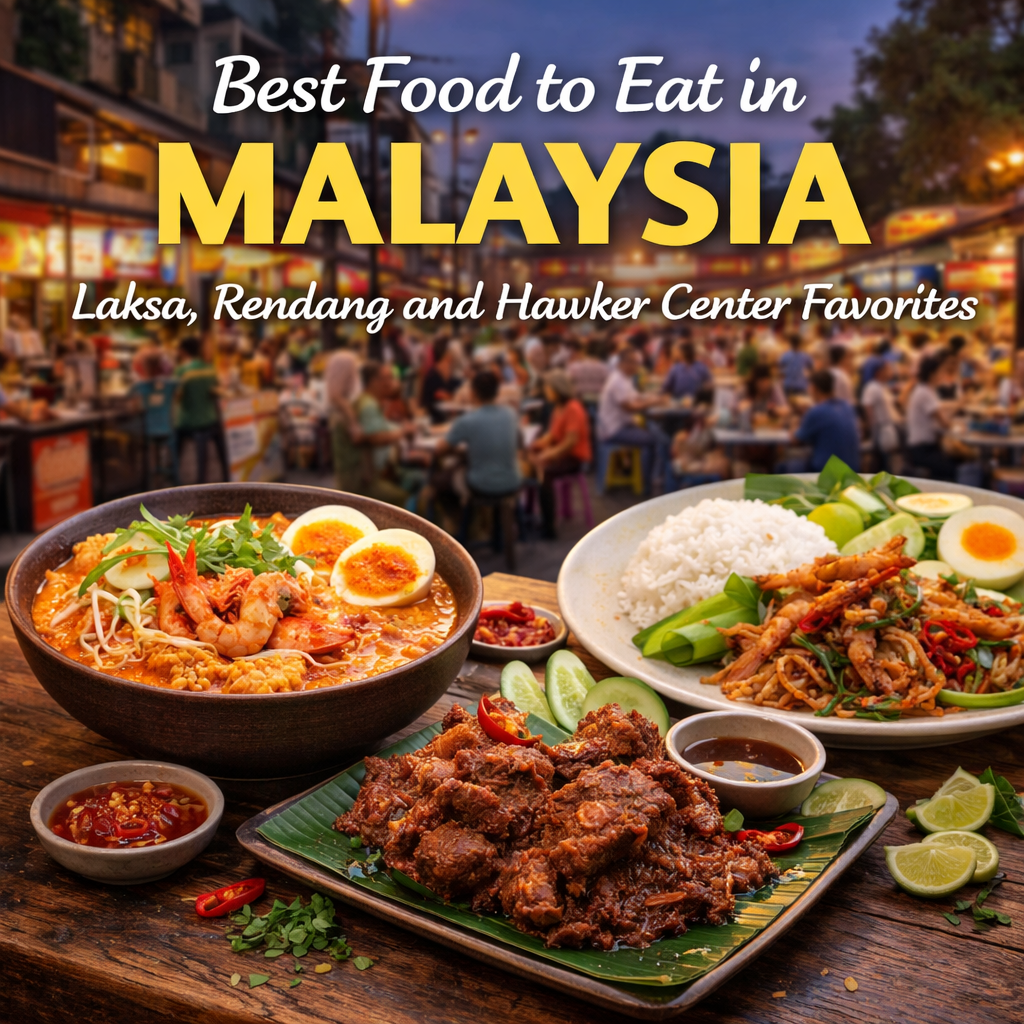
Best Food to Eat in Malaysia: Laksa, Rendang and Hawker Center Favorites
Malaysia is what happens when Malay, Chinese, and Indian cooking traditions collide in the same hawker center for 500 years. The result is the most culinarily diverse country per capita on Earth — a place where you can eat roti canai for breakfast, char kway teow for lunch, and rendang for dinner, all within walking distance, all for under $5 total.
No other country packs this much food variety into such a compact space. In a single Penang hawker center, you’ll find Hokkien noodles cooked by a third-generation Chinese vendor, nasi kandar from an Indian-Muslim stall, Malay laksa from a grandmother who’s been making it since the 1970s, and Nyonya kuih (Peranakan desserts) from a Straits Chinese family. They all share the same plastic tables. They all cost under RM 10 ($2.20 USD). This multicultural food ecosystem is Malaysia’s greatest cultural achievement — and in 2020, Malaysia’s hawker culture was formally recognized by UNESCO. This guide covers all three culinary traditions, 20 must-try dishes, the best hawker centers, regional specialties, prices, and why Malaysia should be your next food trip.
Malaysia is part of our Best Food in Asia guide covering nine top food destinations across the continent.
Malay Food: Coconut, Sambal and the Heart of Malaysian Cuisine
Nasi lemak — the national dish
Fragrant rice cooked in coconut milk and pandan leaves, served with sambal (a sweet-spicy chili paste that’s the soul of the dish), crispy fried anchovies (ikan bilis), roasted peanuts, sliced cucumber, and a hard-boiled or fried egg. That’s the base. From there, you add protein — fried chicken (ayam goreng), rendang, sambal squid, sambal prawn, or fried fish. The simplest version comes wrapped in a banana-leaf cone from roadside stalls for RM 1.50–3 ($0.33–0.65 USD) — one of the world’s great bargain breakfasts. Restaurant versions with premium toppings run RM 8–18 ($1.75–3.95 USD).
Nasi lemak is eaten at all hours. Malaysians eat it for breakfast (the traditional time), lunch, dinner, and as a 2 AM snack. The banana-leaf-wrapped packets sold at petrol stations and roadside stalls at dawn, still warm, are a morning ritual that 33 million Malaysians observe religiously.
Rendang — the slow-cooked masterpiece
Beef (or chicken) braised for hours in coconut milk, lemongrass, galangal, turmeric leaf, chilies, and a paste of shallots, garlic, and ginger until all the liquid evaporates and the spices caramelize into the meat. Malaysian rendang is essentially identical to the Minangkabau Indonesian version — both countries claim it, and both are correct (the Minangkabau people live on both sides of the Strait of Malacca). CNN voters named it the world’s most delicious food. RM 8–15 ($1.75–3.30 USD) at Malay restaurants.
Satay — the charcoal-grilled skewer
Marinated chicken, beef, or mutton threaded onto bamboo skewers, grilled over coconut-shell charcoal, and served with a chunky peanut sauce, compressed rice cubes (nasi impit), sliced cucumber, and raw onion. The best satay has a charred, smoky exterior and a juicy, sweet-savory interior from the turmeric-lemongrass marinade. Kajang (a town south of KL) claims the title of satay capital — Sate Haji Samuri is the most famous. Night market satay vendors across the country are universally excellent. RM 0.80–1.50 per stick ($0.18–0.33 USD) — you order in multiples of 10.
Nasi kandar — Penang’s Indian-Malay hybrid
Rice (plain or biryani-style) served with a flood of curries ladled from a row of metal pots: fish curry, chicken curry, squid curry, dhal, fried chicken, and a dozen vegetable options. The curries mix on the plate, creating a unique flavor combination each time. Originally from Indian-Muslim (Mamak) vendors in Penang who carried the food on shoulder poles (kandar). Line Clear and Nasi Kandar Beratur in Georgetown are legendary — the latter’s name means “queue nasi kandar” because the line is always long. RM 6–15 ($1.32–3.30 USD).
Malaysian sambal (sambal belacan) is different from Indonesian sambal — it’s typically made with dried chilies, shrimp paste (belacan), shallots, lime juice, and sugar, pounded in a mortar. It’s slightly sweeter and less raw than Indonesian versions. Every Malay household has their own sambal recipe. Nasi lemak lives or dies by its sambal — a great sambal maker can charge premium prices. At hawker stalls, sambal is usually free in unlimited quantities.
Chinese-Malaysian Food: Wok Hei, Pork and Tea
Chinese-Malaysians (roughly 23% of the population) brought Hokkien, Teochew, Cantonese, Hakka, and Hainan cooking traditions that have evolved into something distinctly Malaysian over generations. The result is a cuisine that’s recognizably Chinese but found nowhere in China — adapted to tropical ingredients, local palates, and the irresistible pull of sambal and chili.
Char kway teow — Penang’s smoky masterpiece
Flat rice noodles (kway teow) wok-fried over extreme heat with prawns, cockles, Chinese lap cheong sausage, bean sprouts, chives, egg, and dark soy sauce. The critical element is wok hei — the smoky, charred breath of a roaring wok — which can only be achieved at temperatures impossible to replicate at home. The best char kway teow vendors in Penang cook over charcoal, not gas, and the result is a blackened, smoky, slightly sweet plate of noodles that’s one of the most sought-after street food dishes in Asia. RM 6–10 ($1.32–2.20 USD). Sister’s Char Kway Teow and Siam Road Char Kway Teow in Georgetown are the pilgrimage sites.
Bak kut teh — pork bone tea
Pork ribs simmered in a broth of Chinese herbs, garlic, and white pepper until tender, served with rice, fried dough sticks (youtiao), and side dishes of braised tofu, mushrooms, and vegetables. Two styles: Klang style (darker, more herbal, more soy-heavy) from the port town near KL, and Penang style (clearer, more peppery, lighter). Bak kut teh is traditionally breakfast food — serious practitioners wake at 6 AM for their morning bowl. RM 12–25 ($2.64–5.50 USD). Seng Huat in Klang is the most famous.
Hainanese chicken rice
Poached chicken served with fragrant rice cooked in chicken fat and broth, accompanied by a trio of sauces: chili, ginger, and dark soy. The chicken must be silky-smooth with slightly gelatinous skin; the rice must be oily and aromatic. Malaysia and Singapore both claim this dish (it was brought by Hainan immigrants), and the rivalry is fierce. Nasi Ayam Chee Meng in Ipoh and Nam Heong in KL are Malaysian benchmarks. RM 7–14 ($1.54–3.08 USD).
Hokkien mee — two completely different dishes
Penang Hokkien mee is a dark, spicy prawn noodle soup — thick yellow noodles and rice vermicelli in a rich, pork-and-prawn-shell broth, topped with prawns, kangkung (water spinach), and sambal. KL Hokkien mee is stir-fried thick yellow noodles with dark soy sauce, pork lard, and cabbage — darker, sweeter, and completely different. Same name, same ethnic origin, totally different dishes. Both are outstanding. RM 6–12 ($1.32–2.64 USD).
More Chinese-Malaysian essentials
Ipoh hor fun — silky flat rice noodles in a clear prawn broth, or stir-fried with prawns and egg. Ipoh’s water (from limestone caves) is credited for the noodles’ exceptional smoothness. Wan tan mee — springy egg noodles tossed in dark soy with char siu (BBQ pork) and wonton soup on the side. Claypot chicken rice — rice, chicken, Chinese sausage, and dark soy cooked in a clay pot over charcoal until the bottom rice layer forms a crispy, savory crust. Curry mee — yellow noodles in a spicy coconut curry broth with cockles, prawns, and tofu puffs.
The smoky char from a blazing-hot wok (wok hei, literally “breath of the wok”) is the defining quality of Chinese-Malaysian stir-fried noodle dishes. If the noodles don’t have that faint smokiness and slightly charred edges, the dish isn’t right. This is why hawker stall char kway teow tastes better than restaurant versions — the stallholders use higher heat, heavier woks, and decades of muscle memory.
Indian-Malaysian Food: Roti, Banana Leaf and the Mamak Culture
Indian-Malaysians (roughly 7% of the population, mostly Tamil) brought a food tradition that has become one of the pillars of Malaysian culture. Roti canai, banana leaf rice, and mamak stalls are as fundamentally Malaysian as nasi lemak — and mamak culture (the Indian-Muslim food stall tradition, open 24 hours) is arguably Malaysia’s most important late-night dining institution.
Roti canai — the flaky flatbread
A thin, stretchy dough of flour, ghee, and condensed milk, folded and slapped on a flat griddle until flaky, crispy-edged, and layered like puff pastry. Served with dhal (lentil curry) and fish or chicken curry for dipping. The roti maker’s technique — stretching the dough paper-thin, slapping it against the griddle, folding it into layers — is mesmerizing theater. Variations: roti telur (with egg), roti bom (thick, sweet, round), roti tisu (paper-thin crispy cone), roti planta (with margarine and sugar), roti sardin (with canned sardine filling). RM 1.50–4 ($0.33–0.88 USD). Available at every mamak stall, 24 hours a day.
Banana leaf rice
A banana leaf replaces the plate. White rice is mounded in the center, surrounded by vegetable curries (cabbage, rasam, dhal, fried bitter gourd), papadum, pickled vegetables, and a mound of rasam-soaked rice. You add proteins: fried chicken, mutton curry, fish curry, crab curry. Eat with your right hand — mix rice with curry, form a small ball, and push it into your mouth with your thumb. It’s one of the most satisfying meals in Asia. Restoran Sri Nirwana Maju in Bangsar (KL) and Devi’s Corner are institutions. RM 8–18 ($1.75–3.95 USD) for vegetarian, RM 15–30 ($3.30–6.60 USD) with premium proteins.
Mamak stalls — Malaysia’s 24-hour food institution
Mamak stalls are Indian-Muslim eateries open around the clock — they’re Malaysia’s answer to the diner, the pub, and the community center rolled into one. After midnight, mamaks fill with every demographic: students, taxi drivers, families, businessmen. The food: roti canai, mee goreng mamak (fried noodles with a sweet-spicy tomato sauce — completely different from Chinese mee goreng), maggi goreng (stir-fried instant noodles elevated to an art form), nasi goreng mamak, murtabak (stuffed pan-fried bread with minced meat and egg), and teh tarik (pulled tea — Malaysia’s national drink). A full mamak dinner: RM 8–18 ($1.75–3.95 USD).
Malaysia’s national drink: strong black tea brewed with condensed milk, then “pulled” — poured back and forth between two cups from shoulder height to create a thick, frothy foam. The pulling cools the tea and aerates it. The technique is theatrical — mamak stall workers compete in teh tarik pulling competitions. RM 1.50–3 ($0.33–0.66 USD). It’s the perfect accompaniment to roti canai at 2 AM.
Laksa: Malaysia’s Greatest Noodle Soup (in Two Totally Different Versions)
Laksa is Malaysia’s most famous noodle dish — but the name covers two radically different soups, and confusing them is a food crime.
Penang asam laksa — the sour fish soup
A tangy, fishy broth made from mackerel (ikan kembung), tamarind (asam), lemongrass, galangal, chili, and torch ginger flower (bunga kantan) — served over thick rice noodles with shredded fish, cucumber, onion, pineapple, lettuce, and a spoonful of hae ko (dark, pungent shrimp paste). It’s sour, spicy, funky, and completely addictive. CNN ranked Penang asam laksa as the 7th best food in the world. The broth is complex — simultaneously sour from tamarind, savory from fish, aromatic from ginger flower, and funky from shrimp paste. RM 5–10 ($1.10–2.20 USD). Air Itam Asam Laksa near Kek Lok Si temple is the most famous stall.
Curry laksa — the coconut version
A rich, spicy coconut curry broth with yellow noodles and/or rice vermicelli, topped with tofu puffs, prawns, cockles, bean sprouts, and a swirl of sambal. It’s creamy, warming, and less confrontational than asam laksa — the coconut milk softens the chili heat. Found across KL, Penang, and Melaka with regional variations. RM 6–12 ($1.32–2.64 USD).
Sarawak laksa — Borneo’s secret weapon
A totally unique third version from Kuching, Sarawak (Malaysian Borneo): a broth of sambal belacan, coconut milk, sour tamarind, and a complex spice paste, served over rice vermicelli with prawns, chicken shreds, egg strips, and fresh cilantro. Anthony Bourdain called it “the breakfast of the gods.” RM 6–10 ($1.32–2.20 USD) in Kuching. Not widely available outside Borneo — another reason to visit.
Peranakan (Nyonya) Cuisine: The Beautiful Fusion
Peranakan cuisine (also called Nyonya cuisine) is the food of the Straits Chinese — descendants of Chinese traders who married Malay women centuries ago, creating a unique culture that blends both traditions. The food is labor-intensive, aromatic, and more complex than either Malay or Chinese cooking alone. Melaka is the Peranakan heartland, with Georgetown (Penang) close behind.
Nyonya laksa — the original curry laksa, with a more nuanced spice paste than the standard version. Ayam pongteh — chicken braised in fermented soybean paste (taucheo) with potatoes — sweet, savory, and Melaka’s signature dish. Pie tee — crispy pastry cups filled with jicama, prawn, and chili sauce — the ultimate Nyonya appetizer. Otak-otak — spiced fish paste wrapped in banana leaf and grilled over charcoal. Kuih (Nyonya cakes) — technicolor, pandan-scented, coconut-rich layered cakes that are as beautiful as they are delicious. RM 1–3 per piece.
Nyonya Heritage and Capitol Satay (celup — fondue-style satay broth dipping) in Melaka. Auntie Gaik Lean’s Old School Eatery in Georgetown for old-school Nyonya.
Borneo Food: Sarawak and Sabah
Malaysian Borneo (Sarawak and Sabah) has a food culture distinct from Peninsular Malaysia — influenced by Dayak, Bidayuh, and Kadazan indigenous traditions, plus Chinese and Malay immigration.
Kolo mee — Kuching’s signature noodle: springy egg noodles tossed in pork lard and light soy, topped with char siu pork, minced meat, and wonton. Simple, porky, and deeply satisfying. RM 5–8. Sarawak laksa (covered above). Manok pansoh — chicken cooked inside bamboo tubes over an open fire with lemongrass, tapioca leaves, and ginger. An indigenous Dayak dish. Hinava — Kadazan raw fish salad from Sabah, similar to ceviche, with lime, chili, ginger, and sliced shallots. Tuak — Sarawak’s rice wine, served at Dayak longhouse celebrations.
How to Navigate a Malaysian Hawker Center
Hawker centers are Malaysia’s greatest culinary institution — open-air or covered food courts with 20–100 independent stalls, each specializing in one dish. UNESCO recognized Malaysia’s hawker culture in 2020. Eating at hawker centers is not budget dining by default — it’s how all Malaysians eat, from factory workers to CEOs.
The strategy
Grab a table first — leave a packet of tissues or your umbrella to claim it (this is the universal Malaysian table-reservation system). Walk the center once before ordering — scout every stall, check the queues (long line = good food), and plan your meal. Order from multiple stalls — the stalls bring food to your table (or you bring it yourself at simpler centers). Drink stalls are separate — a roaming drink-seller will come to your table, or there’s a dedicated drink stall. Pay each stall individually when the food arrives.
In Malaysian hawker centers, a long queue is the single most reliable quality signal. If 30 people are waiting for one char kway teow stall while the identical-looking stall next door is empty, there’s a reason. Follow the line. Always. Some legendary hawker stalls have 45-minute waits — it’s always worth it.
The best hawker centers in Malaysia
Gurney Drive Hawker Centre (Penang) — the most famous, recently relocated to a new building. Char kway teow, pasembur (Indian-Malay rojak), oh chien (oyster omelet). New Lane (Lorong Baru) (Penang) — locals’ favorite over Gurney. Jalan Alor (KL) — the most tourist-accessible, great variety but slightly higher prices. Imbi Market (KL) — morning-only, exceptional curry mee and Hokkien mee. Top Spot Food Court (Kuching) — a rooftop seafood hawker center with the freshest prawns and fish in Borneo.
Malaysian Desserts and Drinks
Cendol — the king of Malaysian shaved ice
Shaved ice topped with green pandan-flavored rice flour jelly strands, red beans, coconut milk, and a generous pour of gula Melaka (palm sugar syrup — dark, caramel-rich, and the secret weapon of Malaysian desserts). The best cendol uses freshly made jelly, freshly shaved ice, and gula Melaka from Melaka itself. Penang Road Famous Teochew Chendul (Georgetown) has a permanent queue. RM 3–6 ($0.66–1.32 USD).
More Malaysian sweets and drinks
Apam balik — crispy turnover filled with peanuts, sugar, corn, and cream. A night market classic. RM 2–5. Kuih — Nyonya layered cakes in every color (pandan green, coconut white, gula Melaka brown). Ais kacang — Malaysian shaved ice with red beans, corn, grass jelly, agar agar, and syrup. Pisang goreng — deep-fried banana fritters. Roti tisu — paper-thin crispy roti cone drizzled with condensed milk.
Teh tarik (covered above). Kopi — traditional Malaysian coffee roasted with margarine and sugar, resulting in a dark, caramelized, slightly sweet brew. Ipoh white coffee — roasted with palm oil margarine and served with condensed milk, smoother and lighter than standard kopi. Tiger beer and Carlsberg (brewed locally) are the most common beers. Air bandung — a rose-syrup-and-milk drink, bright pink and sweet.
For more on Malaysian coffee traditions in global context, see our Best Coffee Around the World guide.
Best Food Cities in Malaysia
🏮 Penang (Georgetown) — The world’s best street food city
UNESCO World Heritage Site with the densest concentration of excellent hawker food on Earth. The intersection of Malay, Chinese, Indian, and Peranakan traditions at peak quality.
🏙️ Kuala Lumpur — The melting pot capital
The widest variety: every Malaysian regional cuisine plus international food. Jalan Alor is the famous food street; Chow Kit is the local secret. 24-hour mamak stalls everywhere.
☕ Ipoh — The hidden gem
Malaysia’s most underrated food city. Famous for silky noodles (credited to the limestone-filtered water), bean sprout chicken, and white coffee.
🏛️ Melaka — Peranakan paradise
The historical capital of Peranakan culture. Quieter than Penang, more focused, and the best place to experience Nyonya cuisine in its homeland.
🌿 Kuching (Sarawak) — Borneo’s food capital
A food scene unlike anywhere else in Malaysia — indigenous, Chinese, and Malay traditions of Borneo.
Penang consistently ranks among the world’s top street food destinations. See where it lands in our Best Street Food Cities in the World ranking.
Complete Malaysian Dish Guide: Prices, Traditions and Must-Try Rating
| Dish | Tradition | Best City | Price (RM / USD) | Spice | Must-Try |
|---|---|---|---|---|---|
| Nasi Lemak | Malay | Nationwide | 2–18 / $0.44–3.95 | 🌶️🌶️ Med (sambal) | ★★★★★ |
| Char Kway Teow | Chinese | Penang | 6–10 / $1.32–2.20 | 🌶️ Mild | ★★★★★ |
| Penang Asam Laksa | Malay/Chinese | Penang | 5–10 / $1.10–2.20 | 🌶️🌶️ Med-hot | ★★★★★ |
| Roti Canai | Indian | Nationwide | 1.50–4 / $0.33–0.88 | None (curry dip varies) | ★★★★★ |
| Rendang | Malay | Nationwide | 8–15 / $1.75–3.30 | 🌶️🌶️ Med-hot | ★★★★★ |
| Nasi Kandar | Indian-Muslim | Penang | 6–15 / $1.32–3.30 | 🌶️🌶️ Medium | ★★★★★ |
| Satay (10 sticks) | Malay | Kajang | 8–15 / $1.75–3.30 | None | ★★★★★ |
| Curry Laksa | Malay/Chinese | KL/Penang | 6–12 / $1.32–2.64 | 🌶️🌶️ Medium | ★★★★★ |
| Hainanese Chicken Rice | Chinese | Ipoh/KL | 7–14 / $1.54–3.08 | 🌶️ Mild (chili dip) | ★★★★★ |
| Bak Kut Teh | Chinese | Klang | 12–25 / $2.64–5.50 | None | ★★★★★ |
| Banana Leaf Rice | Indian | KL | 8–30 / $1.75–6.60 | 🌶️🌶️ Medium | ★★★★★ |
| Hokkien Mee (Penang) | Chinese | Penang | 6–12 / $1.32–2.64 | 🌶️🌶️ Med-hot | ★★★★☆ |
| Mee Goreng Mamak | Indian-Muslim | Nationwide | 5–10 / $1.10–2.20 | 🌶️ Mild-med | ★★★★☆ |
| Cendol | Malay | Penang/Melaka | 3–6 / $0.66–1.32 | None | ★★★★★ |
| Ipoh Hor Fun | Chinese | Ipoh | 6–10 / $1.32–2.20 | None | ★★★★☆ |
| Sarawak Laksa | Borneo | Kuching | 6–10 / $1.32–2.20 | 🌶️ Mild-med | ★★★★★ |
| Kolo Mee | Chinese-Borneo | Kuching | 5–8 / $1.10–1.75 | None | ★★★★☆ |
| Rojak | Malay/Indian | Penang | 5–10 / $1.10–2.20 | 🌶️ Mild | ★★★★☆ |
| Teh Tarik | Indian-Muslim | Nationwide | 1.50–3 / $0.33–0.66 | None | ★★★★★ |
| Nasi Kerabu | Malay | Kelantan | 5–10 / $1.10–2.20 | 🌶️ Mild | ★★★★☆ |
How to Eat Well in Malaysia on Any Budget
Budget: under RM 25/day ($5.50 USD)
Breakfast: nasi lemak packet (RM 2–3). Lunch: char kway teow or nasi kandar at a hawker center (RM 6–8). Dinner: roti canai with dhal at a mamak (RM 3–5). Drink: teh tarik (RM 1.50–2). Snack: apam balik at a night market (RM 3). Total: RM 15.50–21. This is normal daily eating for many Malaysians, and the quality is world-class.
Mid-range: RM 50–100/day ($11–22 USD)
Breakfast: dim sum or white coffee in Ipoh (RM 15–25). Lunch: banana leaf rice with fried chicken (RM 15–25). Dinner: bak kut teh or seafood at a hawker center (RM 15–30). Dessert: cendol (RM 5). Coffee at a specialty cafe (RM 10–15). This budget delivers exceptional eating every day across all three traditions.
High-end: RM 200+/day ($44+ USD)
Fine dining in KL is excellent and underpriced globally. Dewakan (modern Malaysian, Asia’s 50 Best), Nadodi (modern Indian), DC by Darren Chin (French-Malaysian). A tasting menu at Dewakan: RM 600–800 ($132–176 USD) — comparable to $300+ experiences elsewhere. Bijan for upscale Malay cuisine. Even at the top, Malaysia is dramatically cheaper than Singapore for comparable quality.
Explore More Asian Cuisines
Malaysia is one of nine countries in our Best Food in Asia guide. Its food connects to every neighbor through trade, migration, and shared ingredients:
🇮🇩 Best Food to Eat in Indonesia — the Malay cousins. Rendang, satay, and nasi goreng cross the Strait of Malacca freely. Southern Thai food blends into northern Malaysian food at the border.
🇹🇭 Best Food to Eat in Thailand — southern Thai food (Hat Yai) and northern Malaysian food (Penang) share DNA. The border region is a flavor bridge between the two countries.
🇮🇳 Best Food to Eat in India — Malaysia’s Indian community brought roti, banana leaf meals, and an entire culinary tradition that’s evolved into something distinctly Malaysian-Indian.
🇨🇳 Best Food to Eat in China — Hokkien, Teochew, Cantonese, and Hainan immigrants created Chinese-Malaysian food — recognizably Chinese, but found nowhere in China itself.
🇵🇭 Best Food to Eat in the Philippines — the Malay-Austronesian connection links Filipino, Malaysian, and Indonesian food through shared coconut, vinegar, and seafood traditions.
For the best vegetarian destinations worldwide, including Indian-Malaysian banana leaf options, see our Vegetarian and Vegan Food Travel Guide.