Sugerowany rozmiar: 1200×630px
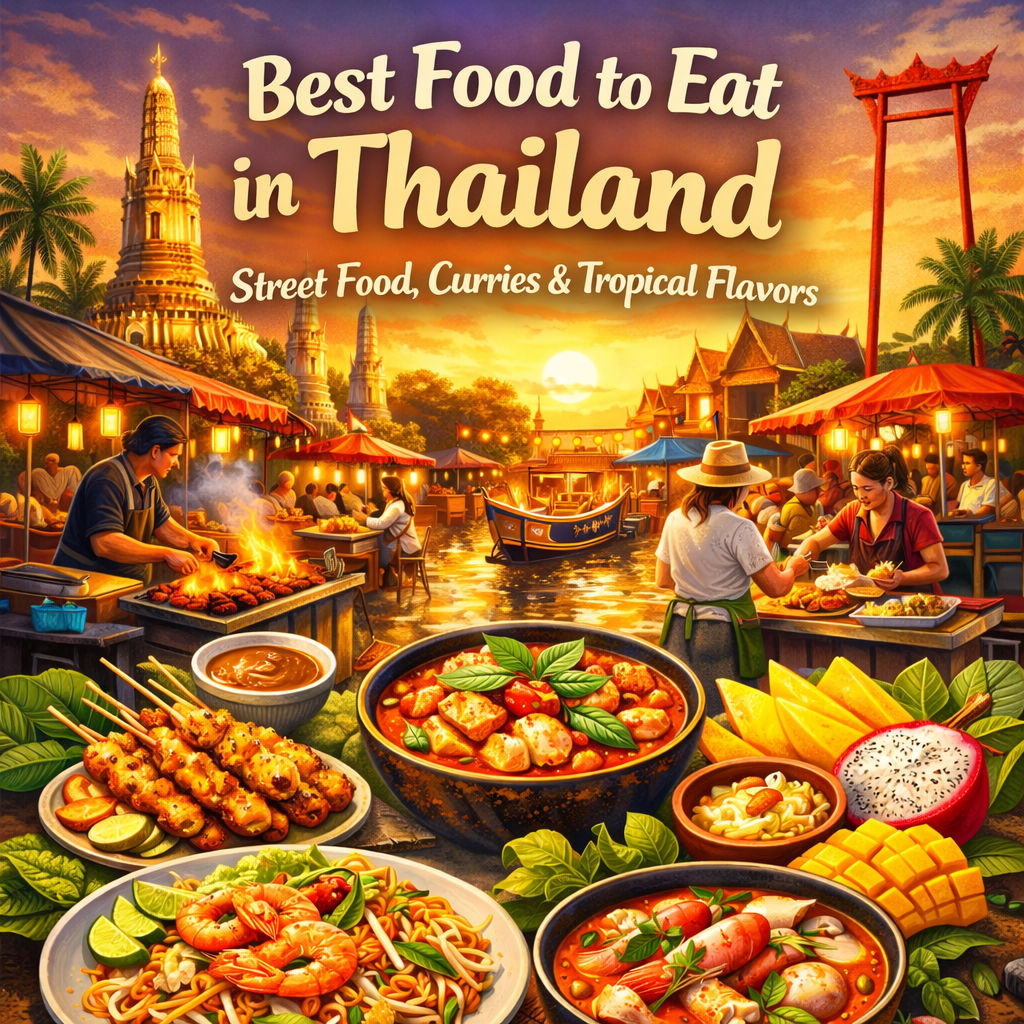
Best Food to Eat in Thailand: Street Food, Curries and Tropical Flavors
Thailand isn’t just the best street food country in Asia — it might be the best food country on Earth, full stop. From the first bite of a properly made pad thai at a Bangkok wok stall to a bowl of golden khao soi in a Chiang Mai backstreet, Thai food hits you with a complexity of flavor that no other cuisine matches at this price point.
Thai cuisine is built on a deceptively simple idea: every dish should balance four flavors — sweet, sour, salty, and spicy — in a single bite. A great green curry achieves this. So does a plate of som tum. So does a 40-baht bowl of boat noodles served from a cart by the canal. This balance is what makes Thai food so addictive and so difficult to replicate outside the country — it’s not one dominant flavor, it’s all of them firing at once. This guide covers 20 must-try dishes, regional differences, the best cities to eat in, prices for everything, and the street food strategies that will have you eating like a local within hours of landing.
Thailand is part of our Best Food in Asia guide covering nine top food destinations across the continent. → See our complete Bangkok food guide
Bangkok Street Food: Why It’s the Best in the World
Bangkok has an estimated 300,000 street food vendors. Some have been cooking the same single dish, in the same spot, for 40 years. A few of them have earned Michelin stars while still serving food from a cart on the sidewalk for under $2. This isn’t a tourist novelty — street food is how most Bangkokians eat every day. Cooking at home is the exception, not the rule, because why would you when there’s a stall on every corner making pad kra pao better than you ever could?
Where to eat street food in Bangkok
Yaowarat Road (Chinatown) is the single best street food destination in Bangkok. After dark, the entire street transforms into an open-air food market — grilled seafood, pad thai, oyster omelets, guay jub (rolled noodle soup), and the famous Nai Ek roll noodles. Go after 7 PM, walk slowly, and follow the smoke.
Victory Monument area is where locals eat. Boat noodle alley (on the side streets) serves tiny, intensely flavored bowls for 15–20 baht each — you order five or six and stack the bowls. The surrounding streets have outstanding pad kra pao, som tum, and khao man gai stalls.
Or Tor Kor Market (next to Chatuchak) is Bangkok’s premium fresh market — the cleanest, most curated food market in the city. Curry stalls, pre-made dishes, tropical fruit at peak ripeness, and a famous khao niew mamuang (mango sticky rice) vendor.
Silom Soi 20 is a lunch-only street food corridor — rice-and-curry stalls where you point at what you want and pay 40–60 baht for a plate of rice with two or three toppings. Office workers pile in from 11 AM. By 1:30 PM everything is sold out.
The best street food in Thailand comes from vendors who cook only one thing. A stall that serves pad thai, fried rice, tom yum, AND green curry probably does none of them well. A stall that serves ONLY pad thai, with a line of 30 people — that’s the one. In Bangkok, specialization equals quality.
Thai Curries Explained: Green, Red, Massaman and Beyond
Thai curries are nothing like Indian curries. They’re built on a wet paste (pounded by hand in a mortar — khrok) of fresh chilies, lemongrass, galangal, kaffir lime leaves, garlic, shallots, and shrimp paste, then simmered in coconut milk. The result is brighter, more aromatic, and more herbaceous than any other curry tradition. Each color and region produces a radically different dish.
Green curry (gaeng keow wan)
Thailand’s most famous curry — bright green from fresh green chilies and Thai basil, rich from coconut cream, fragrant from kaffir lime and lemongrass. Typically made with chicken or beef, pea eggplants, and bamboo shoots. The “sweet” in its Thai name (wan) refers to the sweetness of the green chilies, not the dish — it’s usually quite spicy. 60–100 baht ($1.70–2.85 USD) at street level, 150–300 baht ($4.30–8.50 USD) at restaurants.
Red curry (gaeng daeng)
Made with dried red chilies, giving it a deeper, slightly less sharp heat than green curry. Often cooked with duck (gaeng daeng ped yang — roast duck red curry) or with pineapple chunks that cut through the richness. Some consider it more balanced than green curry — the red chili heat builds slowly rather than hitting immediately.
Massaman curry (gaeng massaman)
Thailand’s mildest, richest curry — a southern specialty with Persian and Indian influences. Warm spices (cardamom, cinnamon, star anise, cumin) meet coconut cream, potatoes, peanuts, and slow-braised beef or chicken. It’s the curry for people who don’t love spicy food, and it’s genuinely one of the best dishes in the world. CNN’s readers voted massaman the world’s best food in 2011, and it regularly appears in top-10 global dish rankings.
Panang curry (gaeng panang)
Thicker and creamier than green or red curry — the paste includes ground roasted peanuts, which give it a slightly nutty richness. Served with a drizzle of thick coconut cream on top and shredded kaffir lime leaves. Less soupy than other curries, more like a thick sauce coating the meat. Outstanding with beef.
Yellow curry (gaeng luang)
The mildest Thai curry, turmeric-heavy with a golden color, often made with potatoes, onions, and chicken. Popular in southern Thailand and heavily influenced by Indian curry traditions. A gentle entry point for spice-shy travelers.
The difference between a transcendent Thai curry and an average one is often the coconut milk. Street stalls and traditional restaurants use freshly squeezed coconut cream (hua ka-ti — the thick, rich first press) separated from the thinner coconut milk. The cream is heated first until it “cracks” (oil separates), then the paste is fried in the coconut oil. You can’t replicate this with canned milk — which is why Thai curries taste better in Thailand than anywhere else.
Thai Salads: Som Tum and the Art of Pounding Flavor
Thai salads (yam) are explosive — every one is a live-wire combination of sour, spicy, salty, and sweet, served at room temperature and designed to be eaten with sticky rice or jasmine rice. They’re the dishes Thais eat most often at home and at street stalls, even though tourists tend to default to curries and pad thai.
Som tum — green papaya salad
The most important dish in Thai food, period. Shredded green papaya pounded in a clay mortar with garlic, bird’s eye chilies, green beans, tomatoes, dried shrimp, peanuts, palm sugar, fish sauce, and lime juice. Each portion is made to order — the vendor pounds the ingredients together with a pestle, adjusting the balance as she goes. The standard version (som tum thai) is the most accessible. The Isaan version (som tum poo pla ra) uses fermented crab and fish — funky, intense, and an acquired taste. 40–60 baht ($1.15–1.70 USD).
Larb — the minced meat salad
Laos and Isaan’s most famous contribution to the Thai table. Minced pork, chicken, duck, or fish tossed with roasted rice powder (khao khua — which gives it a nutty, smoky crunch), lime juice, fish sauce, chilies, mint, and shallots. Eaten with sticky rice. The texture of the toasted rice powder is what makes larb unique — nothing else in world cuisine has that particular gritty crunch. 50–80 baht ($1.43–2.28 USD).
Nam tok — waterfall beef salad
Grilled beef (or pork), sliced thin while still warm, tossed with the same larb dressing — lime, fish sauce, chilies, roasted rice powder, shallots, and mint. Called “waterfall” (nam tok) because the meat juices drip onto the charcoal during grilling, causing a sizzle and steam that looks like a waterfall. It’s beefy, smoky, sour, and spicy all at once.
Yam wun sen — glass noodle salad
Slippery mung bean glass noodles tossed with minced pork, shrimp, celery, onions, tomatoes, and a searing lime-chili-fish sauce dressing. Served cold or room temperature. Lighter than it looks, and the contrast between the cool noodles and the fiery dressing is addictive.
Thai Soups: Tom Yum, Tom Kha and Boat Noodles
Tom yum goong — hot-and-sour shrimp soup
If green curry is Thailand’s most popular curry, tom yum goong is its most iconic soup — a clear (or creamy, in the nam khon version) broth that hits you with lemongrass, galangal, kaffir lime leaves, bird’s eye chilies, and a squeeze of lime. The “tom” means boiled, “yum” means mixed, “goong” means shrimp. The shrimp are head-on, shell-on — the heads contain the most flavor. River prawns (goong mae nam) are the premium version. 80–200 baht ($2.28–5.70 USD).
Tom kha gai — coconut chicken soup
Tom yum’s gentler sibling. Chicken simmered in coconut milk with galangal (kha), lemongrass, kaffir lime, and mushrooms. It’s creamy, slightly sweet, and aromatic rather than aggressively sour and spicy. The galangal gives it a distinctive piney, almost citrusy warmth that’s completely different from ginger. Many travelers who find tom yum too intense fall in love with tom kha. 70–150 baht ($2–4.28 USD).
Boat noodles (kuay teow reua)
Tiny bowls — almost shot-glass sized — of intensely flavored noodle soup, originally sold from boats along Bangkok’s canals. The broth is dark, rich, and often includes a splash of pork or beef blood (which sounds alarming but gives it a deep, velvety body). Thin rice noodles, sliced meat, meatballs, morning glory, and bean sprouts. You order multiple bowls — 5 to 10 is standard — and stack the empties. 15–25 baht per bowl ($0.43–0.71 USD). The best clusters are near Victory Monument and along the Saen Saep canal.
Boat noodle culture is about quantity, not restraint. Order your first bowl, slurp it in 30 seconds, stack the bowl, order another. Repeat until you have a tower. Locals often eat 8–12 bowls. Even at 10 bowls, you’ve spent 200 baht ($5.70) for one of the most intensely flavored noodle experiences in Asia.
Stir-Fries and Noodle Dishes: The Everyday Workhorses
Pad thai
The dish that introduced the world to Thai food — wok-fried rice noodles with egg, tofu, dried shrimp, bean sprouts, chives, crushed peanuts, and a tamarind-based sauce. The best versions are cooked in a searing-hot wok with shrimp or a whole crab, wrapped in a thin egg crepe. Thip Samai on Mahachai Road in Bangkok is the most famous pad thai stall in the country — the line starts at 5 PM and stretches around the block, but moves fast. Their “superb” pad thai wrapped in egg is 80 baht ($2.28 USD). Pad Thai Fai Ta Lu on Dinso Road is the locals’ alternative — cooked over charcoal, darker, smokier.
Pad kra pao — holy basil stir-fry
This is the dish Thais eat most often — minced pork (or chicken, beef, seafood) stir-fried with holy basil (bai kra pao), garlic, chilies, and a splash of oyster and fish sauce, served over rice with a crispy fried egg (kai dao) on top. It’s fast, cheap, intensely savory, and available at every single rice-and-curry stall in the country. The fried egg is non-negotiable — puncture the yolk and let it run into the rice. 40–60 baht ($1.15–1.70 USD). If you eat only one street food dish in Thailand, this should be it.
Don’t be fooled by the humble appearance — this dish is often the spiciest thing on a Thai street stall’s menu. The holy basil itself has a peppery kick, and most cooks add bird’s eye chilies liberally. Ask “phet nit noi” (a little spicy) if you’re not sure of your tolerance. The default heat level is designed for Thai palates, which is significantly above most Western comfort zones.
Pad see ew — the sweet soy noodle dish
Wide rice noodles (sen yai) stir-fried with dark soy sauce, Chinese broccoli (kai lan), egg, and your choice of protein. The wok char (known as khao wok) is what separates great pad see ew from average — the noodles should have slightly blackened, smoky edges from contact with a screaming-hot wok. It’s one of the least spicy Thai dishes, making it a safe order for children and spice-shy eaters. 50–80 baht ($1.43–2.28 USD).
Khao pad — Thai fried rice
Jasmine rice wok-fried with egg, onion, and your choice of protein (chicken, pork, shrimp, crab), seasoned with fish sauce, soy sauce, and white pepper. Served with a lime wedge, cucumber slices, and a long chili on the side. Simple, reliable, and universally available. The crab version (khao pad poo) at seaside restaurants is worth the premium. 50–100 baht ($1.43–2.85 USD).
Khao man gai — Thai chicken rice
Poached chicken served over fragrant rice cooked in chicken broth, with a side of clear chicken soup and three dipping sauces (ginger, chili-vinegar, sweet soy). It’s Thailand’s version of Hainanese chicken rice — silky, comforting, and deceptively difficult to make well. The legendary Kuang Heng on Petchaburi Road has served it since the 1940s. 50–70 baht ($1.43–2 USD).
Northern Thai Food: What to Eat in Chiang Mai
Northern Thai (Lanna) cuisine is a different world from Bangkok food. It’s milder, earthier, less coconut-dependent, and deeply influenced by neighboring Myanmar (Burma) and Laos. The staple carb is sticky rice (khao niew), not jasmine rice — you pull off small balls with your fingers and use them to scoop up relishes and dips. The flavors are more subdued but no less complex.
Khao soi — Chiang Mai’s crown jewel
A rich coconut curry broth (with Burmese-influenced spices — turmeric, coriander, cardamom) ladled over soft egg noodles, topped with crispy deep-fried noodles for crunch, served with pickled mustard greens, shallots, and lime on the side. The combination of textures — soft noodles, crispy noodles, crunchy shallots, creamy broth — is unlike anything else in Thai food. Usually made with chicken drumstick (gai) or beef (neua). 50–80 baht ($1.43–2.28 USD). Khao Soi Khun Yai on Charoenrat Road and Khao Soi Mae Sai are local favorites.
Sai ua — northern Thai sausage
A coiled, grilled pork sausage packed with lemongrass, kaffir lime, galangal, chilies, and a complex spice paste. It’s herbaceous and aromatic rather than purely spicy, with a coarse texture that’s more rustic than smooth European sausage. Sliced and served with sticky rice, raw cabbage, and a ginger-peanut dip. Available at every night market in Chiang Mai. 30–50 baht for a generous portion.
Khantoke dinner — the northern Thai feast
A traditional Lanna meal served on a low, round tray (khantoke): sticky rice in a bamboo basket surrounded by small dishes of nam prik (chili relishes), sai ua, gaeng hang lay (Burmese-style pork belly curry), deep-fried pork skin, laab muang (northern-style larb with blood and offal), and steamed vegetables. Tourist versions with cultural performances are available, but the best khantoke is at family-style restaurants like Huen Phen in Chiang Mai’s old city.
More northern essentials
Gaeng hang lay — a thick, sweet-savory pork belly curry with tamarind, ginger, and peanuts, Burmese in origin. Nam prik ong — a tomato-chili relish with minced pork, eaten with vegetables and sticky rice. Khao kha moo — braised pork leg over rice, available at street stalls and startlingly good. Kanom jeen nam ngiew — rice noodles in a pork-tomato broth with blood cubes and fermented soybean.
Southern Thai Food: Spice, Seafood and Turmeric
Southern Thailand is where the heat gets serious. This is the spiciest regional cuisine in the country, influenced by Malay and Muslim cooking traditions (especially in the deep south near the Malaysian border). Turmeric replaces galangal in many dishes, coconut cream is thinner and less sweet, and seafood dominates. Phuket, Krabi, and especially Hat Yai are the food hubs.
Gaeng tai pla — fermented fish kidney curry
The dish that terrifies tourists and delights locals. A thin, searing-hot curry made with fermented fish kidneys (tai pla), bamboo shoots, and an arsenal of dried chilies. The funky, umami-rich depth of the fermented fish is overwhelming in the best possible way. This is not a beginner dish — but it’s the most authentically southern Thai thing you can eat.
Khua kling — dry-fried curry
Minced meat (usually pork or beef) stir-fried with a dry southern curry paste until the moisture evaporates, leaving behind an intensely concentrated, fiery, aromatic mince. No coconut milk, no broth — just pure, undiluted curry paste and meat. Eaten with rice. It’s a chili endurance test and a revelation.
Fresh seafood southern style
Southern Thailand’s coastline delivers some of the best seafood in Asia. Pla pao — whole fish stuffed with lemongrass, wrapped in banana leaves, and grilled over charcoal, served with a spicy seafood sauce. Goong phao — giant river prawns grilled whole, split and eaten with seafood chili dip. Hor mok talay — a delicate seafood custard steamed in banana leaf cups with curry paste and coconut cream. At beachside restaurants in Krabi or Phuket, a seafood dinner for two runs 400–800 baht ($11.40–22.80 USD).
For more on how Malaysian food and southern Thai food influence each other (especially in the border towns), see our Malaysia guide.
Isaan Food: Thailand’s Spicy, Funky Northeastern Soul Food
Isaan (northeastern Thailand, bordering Laos) is the culinary engine of the country. Isaan people make up a huge percentage of Bangkok’s population, which means Isaan food is everywhere in the capital — every third street stall serves som tum, larb, and nam tok. The flavor profile is aggressive: sour (lime), spicy (bird’s eye chili), salty (fish sauce), and funky (fermented fish — pla ra). Sticky rice is the staple, eaten with the fingers.
The Isaan holy trinity
Som tum + larb + sticky rice is the foundational Isaan meal. Order all three, tear off a ball of sticky rice, use it to scoop up larb or pinch a strand of papaya from the som tum, and you’re eating exactly what 20 million northeastern Thais eat every single day. Add a plate of gai yang (grilled chicken marinated in garlic, cilantro root, and white pepper) and you have the complete Isaan feast for under 200 baht ($5.70 USD).
Gai yang — Isaan grilled chicken
A whole chicken (or half), marinated in a paste of garlic, cilantro root, white pepper, and fish sauce, then slowly grilled over charcoal until the skin crackles and the meat is juicy throughout. Served with sticky rice and a spicy tamarind dipping sauce (jaew). Every bus stop, every highway rest area, and every market in Isaan has a gai yang vendor. It’s roadside food elevated to art. Half chicken: 80–120 baht ($2.28–3.42 USD).
Isaan sausage (sai krok Isaan)
Fermented pork-and-rice sausages, grilled until charred and smoky, served with raw cabbage, sliced ginger, bird’s eye chilies, and roasted peanuts. The fermentation gives them a tangy sourness that’s completely different from European sausage. They pop and sizzle on the grill and are sold at every market for 20–40 baht.
Thai Desserts and Sweets: Mango Sticky Rice and Beyond
Khao niew mamuang — mango sticky rice
The single greatest tropical dessert on Earth. Ripe, golden Nam Dok Mai mango (the sweetest, most fragrant variety) served with warm sticky rice that’s been soaked in sweetened coconut cream, drizzled with more coconut cream and a sprinkle of crispy mung beans. The combination of warm, sweet, coconut-soaked rice against cool, juicy mango is transcendent. Peak season is April to June — this is when the mangoes are perfect. 60–100 baht ($1.70–2.85 USD). Available year-round but noticeably better in season.
Roti with condensed milk and banana
A Muslim-influenced street dessert: thin, stretchy dough (like Indian paratha) fried on a flat griddle until crispy and flaky, then filled with banana, drizzled with sweetened condensed milk, and sometimes topped with chocolate sauce, egg, or Nutella. The best roti makers flip and stretch the dough theatrically before slapping it on the griddle. Found at night markets everywhere. 30–60 baht ($0.85–1.70 USD).
More Thai sweets
Khanom buang — crispy Thai crepes filled with meringue-like cream and sweet shredded coconut or foy thong (golden egg threads). Bua loy — colorful glutinous rice balls (often taro-purple and pandan-green) in warm coconut cream. Tub tim krob — water chestnut cubes coated in tapioca, dyed red, served in sweetened coconut milk over ice. Kluay tod — deep-fried banana fritters, crispy outside, molten inside. I-tim kati — coconut milk ice cream served in a bun with peanuts, corn, and sticky rice.
Thai Drinks: Iced Tea, Coffee and Things You’ve Never Tried
Thai iced tea (cha yen) — strong black tea brewed with star anise and tamarind, dyed orange, sweetened heavily, and served over ice with a pour of evaporated milk or condensed milk. It’s blindingly sweet and absolutely perfect in Bangkok’s heat. 25–40 baht ($0.71–1.14 USD).
Thai iced coffee (oliang) — a darker, more bitter brew traditionally made with roasted corn, soybeans, and sesame seeds blended with coffee. Stronger and more complex than standard iced coffee. The pour-over version using a cloth filter (tung tom) is theatrically satisfying to watch. 25–40 baht.
Fresh coconut water — young coconuts hacked open with a machete, a straw inserted, and served cold. Available everywhere for 30–50 baht. After the water, ask the vendor to split it so you can scoop the soft coconut flesh.
Nam ma-now — fresh lime juice with sugar and a pinch of salt. Sounds simple, but the salt-lime-sweet combination is the most refreshing drink in Southeast Asia. 20–30 baht.
Singha, Chang, and Leo are the big three Thai beers — Singha is the most respected, Chang is the strongest (6.4%), Leo is the smoothest. A large bottle at a restaurant: 70–120 baht ($2–3.42 USD). At 7-Eleven: 45–60 baht.
Best Food Cities in Thailand
🏙️ Bangkok — The undisputed champion
Every regional Thai cuisine represented, 300,000+ street vendors, Michelin-starred stalls, and the widest variety of international food in Southeast Asia.
🏔️ Chiang Mai — Northern Thai heartland
Relaxed, affordable, and unique. Night markets are the highlight — Warorot Market for daytime eating, Saturday/Sunday walking streets for evening snacking.
🏖️ Phuket & Krabi — Southern seafood paradise
Coastal Thai food at its best. Mix of Thai-Chinese Peranakan (Baba) cuisine in Phuket Old Town and raw southern Thai spice.
🚂 Hat Yai — The border food capital
Near the Malaysian border, Hat Yai blends Thai, Malay, and Chinese flavors into a street food scene that rivals Bangkok for intensity.
Bangkok regularly ranks among the best food cities on the planet. See where it lands in our Best Street Food Cities in the World ranking.
Complete Thai Dish Guide: Prices, Regions and Must-Try Rating
| Dish | Type | Region | Price (฿ / USD) | Spice | Must-Try |
|---|---|---|---|---|---|
| Pad Thai | Noodles | Central | 60–100 / $1.70–2.85 | Mild | ★★★★★ |
| Pad Kra Pao | Stir-fry | Central | 40–60 / $1.15–1.70 | 🌶️🌶️🌶️ Hot | ★★★★★ |
| Green Curry | Curry | Central | 60–150 / $1.70–4.28 | 🌶️🌶️ Med-hot | ★★★★★ |
| Som Tum | Salad | Isaan | 40–60 / $1.15–1.70 | 🌶️🌶️🌶️ Hot | ★★★★★ |
| Tom Yum Goong | Soup | Central | 80–200 / $2.28–5.70 | 🌶️🌶️ Med-hot | ★★★★★ |
| Massaman Curry | Curry | South | 80–200 / $2.28–5.70 | 🌶️ Mild | ★★★★★ |
| Khao Soi | Noodle soup | North | 50–80 / $1.43–2.28 | 🌶️ Mild-med | ★★★★★ |
| Mango Sticky Rice | Dessert | Central | 60–100 / $1.70–2.85 | None | ★★★★★ |
| Larb | Salad | Isaan | 50–80 / $1.43–2.28 | 🌶️🌶️ Med-hot | ★★★★★ |
| Boat Noodles | Noodle soup | Central | 15–25/bowl / $0.43–0.71 | 🌶️ Mild | ★★★★★ |
| Pad See Ew | Noodles | Central | 50–80 / $1.43–2.28 | None | ★★★★☆ |
| Khao Man Gai | Rice | Central | 50–70 / $1.43–2.00 | None | ★★★★☆ |
| Red Curry | Curry | Central | 60–150 / $1.70–4.28 | 🌶️🌶️ Med-hot | ★★★★☆ |
| Tom Kha Gai | Soup | Central | 70–150 / $2.00–4.28 | 🌶️ Mild | ★★★★☆ |
| Gai Yang | Grilled | Isaan | 80–120 / $2.28–3.42 | 🌶️ Mild | ★★★★☆ |
| Sai Ua | Sausage | North | 30–50 / $0.85–1.43 | 🌶️🌶️ Medium | ★★★★☆ |
| Satay | Grilled | South/Central | 10–15/skewer / $0.28–0.43 | None | ★★★★☆ |
| Panang Curry | Curry | Central | 70–150 / $2.00–4.28 | 🌶️ Mild-med | ★★★★☆ |
| Nam Tok | Salad | Isaan | 50–80 / $1.43–2.28 | 🌶️🌶️ Med-hot | ★★★★☆ |
| Roti + Condensed Milk | Dessert | South | 30–60 / $0.85–1.70 | None | ★★★★☆ |
How to Handle Thai Spice: A Survival Guide
Thai spice isn’t macho posturing — it’s built into the flavor architecture. A properly spicy som tum tastes better than a mild one because the chili heat activates different taste receptors and makes the sour, sweet, and salty elements pop. But you need to find your level.
Key phrases: “Mai phet” = not spicy. “Phet nit noi” = a little spicy. “Phet maak” = very spicy (use this only if you mean it). “Phet Thai” = Thai-level spicy (absolute fire — this is a challenge, not an order).
The escalation strategy: Start with pad see ew, khao man gai, and satay (zero to mild heat). Move to green curry and pad thai (moderate). Graduate to som tum, larb, and boat noodles (hot). Once you can handle those comfortably, try pad kra pao “phet maak” and southern Thai curries. By the end of two weeks, your spice tolerance will have tripled.
Cooling agents: Plain rice is the best neutralizer — not water, which spreads capsaicin. Coconut milk (in curries, desserts, or iced coconut water) also helps. Sweet things work: mango sticky rice after a fiery som tum is a strategic genius move.
How to Eat Well in Thailand on Any Budget
Budget: under 300 baht/day ($8.50 USD)
Breakfast: rice porridge (jok) or fried rice from a morning stall (30–40 baht). Lunch: pad kra pao or rice-and-curry at a street stall (40–60 baht). Dinner: boat noodles — 6 bowls (120 baht). Snack: fruit from a cart (20 baht). Drinks: iced coffee (25 baht). Total: 235–265 baht ($6.70–7.55 USD). This is genuinely achievable and the food is excellent.
Mid-range: 500–1,000 baht/day ($14–28.50 USD)
Breakfast: khao man gai or noodle soup (50–70 baht). Lunch: sit-down restaurant — green curry, tom yum, or pad thai (120–200 baht). Dinner: seafood restaurant or night market with multiple dishes (200–400 baht). Dessert: mango sticky rice (80 baht). This budget lets you eat at the best stalls and mid-range restaurants in the country.
High-end: 2,000+ baht/day ($57+ USD)
Fine dining in Bangkok is world-class and dramatically cheaper than equivalent quality in Tokyo, Paris, or New York. Gaggan Anand (progressive Indian — Bangkok’s most famous restaurant), Le Du (modern Thai), Nahm (traditional Thai), Jay Fai (Michelin-starred street food — her crab omelet costs 1,000 baht but is worth every baht). A high-end dinner: 1,500–5,000 baht ($43–143 USD) per person.
Explore More Asian Cuisines
Thailand is one of nine countries in our Best Food in Asia guide. If you’re planning a multi-country food trip, these neighboring cuisines pair beautifully with Thailand:
🇻🇳 Best Food to Eat in Vietnam — lighter, herb-driven, and equally cheap. Vietnam and Thailand share some ingredients but the flavor profiles are worlds apart — the perfect contrast pairing.
🇲🇾 Best Food to Eat in Malaysia — southern Thai food bleeds into Malaysian cuisine at the border. If you loved Hat Yai, you’ll love Penang.
🇮🇳 Best Food to Eat in India — Thailand’s curries descended from Indian trading routes centuries ago. Taste the connection between massaman curry and Indian masala traditions.
🇯🇵 Best Food to Eat in Japan — the polar opposite of Thai food in approach (precision vs. improvisation, subtlety vs. boldness) and a fascinating culinary counterpoint on the same trip.
For the definitive global street food ranking, including Bangkok’s top spot, see Best Street Food Cities in the World.