Sugerowany rozmiar: 1200×630px
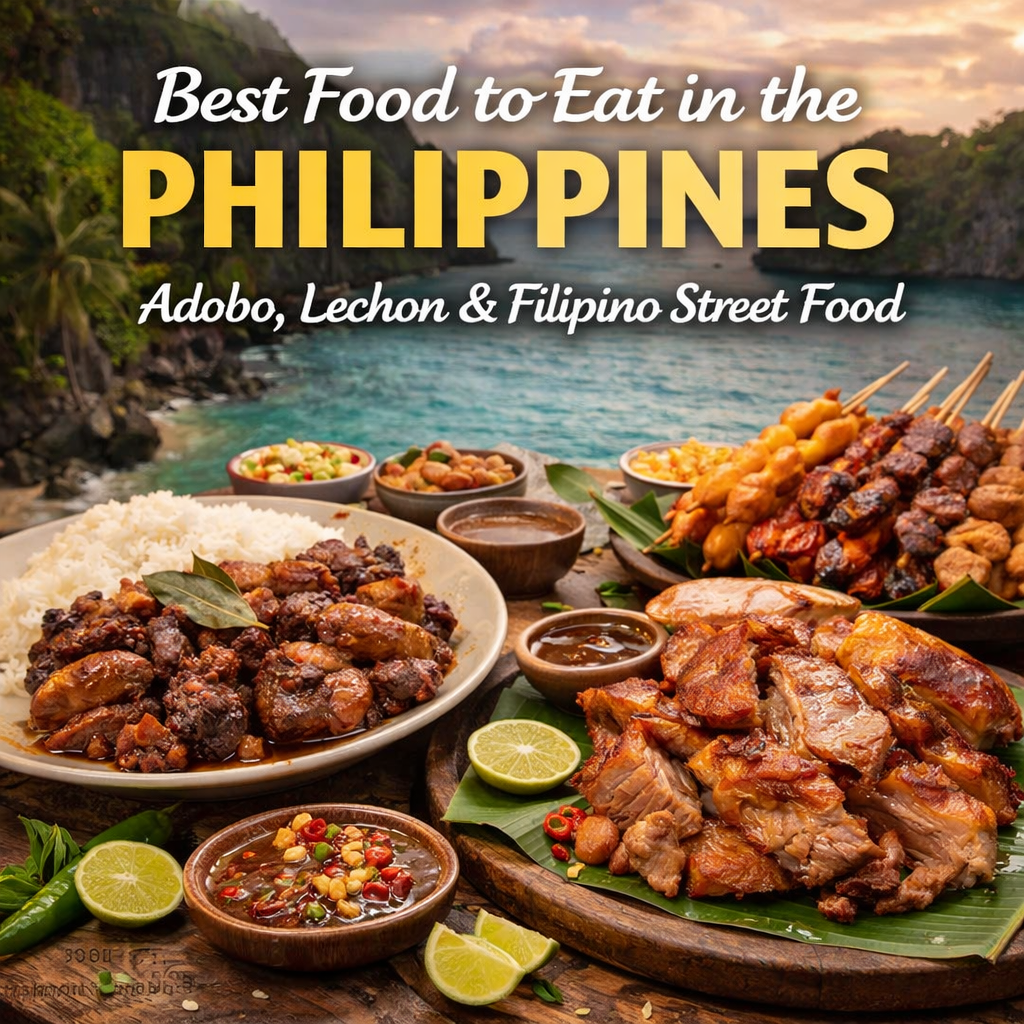
Best Food to Eat in the Philippines: Adobo, Lechon and Filipino Street Food
Filipino food is Asia’s most underrated cuisine — and the world is finally catching on. Built on four centuries of Malay, Chinese, Spanish, and American influence layered into something entirely its own, Philippine cuisine is bold, sour, sweet, rich, and unapologetically comfort-driven. From the sizzling sisig of Pampanga to the lechon of Cebu to Manila’s midnight street food stalls, this is food that hugs you.
For decades, Filipino food was the missing piece of the global Asian food conversation. Thai, Japanese, Vietnamese, and Chinese restaurants spread worldwide while Filipino cuisine stayed home. That’s changing fast — adobo has entered the international lexicon, lechon is recognized as one of the world’s great roasted meats, and Filipino restaurants from Los Angeles to London are winning critical acclaim. But the best Filipino food is still in the Philippines, cooked by a lola (grandmother) in her kitchen, served at a carinderia (local eatery) for under $2, or spread on banana leaves at a communal boodle fight where everyone eats with their hands. This guide covers 20 essential dishes, the regional differences, street food culture, prices, and why your next food trip should be to the Philippines.
The Philippines is part of our Best Food in Asia guide covering nine top food destinations across the continent.
Adobo: The Dish That Defines the Philippines
Adobo is to the Philippines what pasta is to Italy — not just a dish but a cooking philosophy. At its core, adobo means protein (chicken, pork, or both) braised in vinegar, soy sauce, garlic, bay leaves, and whole black peppercorns until the meat is fork-tender and the sauce has reduced to a thick, glossy, intensely savory glaze. That’s the foundation. From there, the variations are infinite — every Filipino family has their own recipe, and claiming one version is “authentic” will start an argument that lasts generations.
The classic Manila adobo is soy-heavy, dark, and saucy — the meat swims in a rich, vinegar-soy braising liquid. Visayan adobo (from Cebu and the central islands) often uses no soy sauce at all — just vinegar, salt, and garlic, producing a lighter, more acidic version called adobong puti (white adobo). Adobo sa gata adds coconut milk, turning the sauce creamy and slightly sweet — a Bicol Region specialty. Dry adobo (adobong tuyo) reduces the sauce completely until the meat is coated in caramelized, almost crispy glaze. Some families add pineapple. Some add sugar. Some use coconut vinegar; others cane vinegar; a few swear by palm vinegar from Laguna.
The one non-negotiable: adobo needs rice. White, steaming, slightly sticky jasmine rice that absorbs the sauce. A plate of adobo without rice is incomplete. ₱80–180 ($1.40–3.15 USD) at carinderias and local restaurants.
Filipino adobo has nothing to do with Mexican or Spanish adobo. When Spanish colonizers arrived in the 16th century, they saw Filipinos braising meat in vinegar and called it “adobo” (from the Spanish adobar — to marinate). But the cooking technique was already indigenous to the Philippines long before Spain arrived. The vinegar-braising preserved meat in the tropical heat before refrigeration existed. So the name is Spanish; the technique is purely Filipino.
Lechon: The Greatest Roast Pig on Earth
Lechon — a whole pig spit-roasted over charcoal for 4–6 hours until the skin is a uniform, deep mahogany red that shatters like stained glass when you tap it — is the centerpiece of every Filipino celebration. Birthdays, weddings, fiestas, Christmas, even ordinary Sundays if someone is feeling generous. Anthony Bourdain called Cebu lechon “the best pig ever.” He wasn’t exaggerating.
Cebu lechon vs. Manila lechon
Cebu lechon is stuffed with lemongrass, garlic, scallions, and a spice mix before roasting — the herbs permeate the meat from the inside out. The skin is thinner and crispier. No sauce is needed or wanted — Cebu locals consider liver sauce an insult to properly made lechon. Zubuchon (from the Zubuche brand) is widely regarded as the best in Cebu. CnT Lechon and Rico’s Lechon are fierce competitors.
Manila lechon is less seasoned inside — the meat is more neutral, and the dish relies on sarsa (liver sauce) for flavor. The sauce is made from liver, vinegar, brown sugar, and breadcrumbs — tangy, savory, and a divisive condiment that Cebuanos refuse to acknowledge.
A whole lechon feeds 30–50 people and costs ₱5,000–12,000 ($87–210 USD) depending on size and quality. Individual portions at lechon restaurants or roadsides: ₱120–250 ($2.10–4.40 USD) for a plate with rice.
Lechon kawali — the everyday alternative
When you can’t spit-roast a whole pig, there’s lechon kawali — pork belly boiled until tender, then deep-fried in a kawali (wok) until the skin puffs and crackles. Served chopped, with spiced vinegar dip and rice. It’s faster, cheaper, and available at every carinderia. The skin should shatter; the meat should be juicy underneath. ₱80–150 ($1.40–2.60 USD).
The Sour Side: Sinigang, Kinilaw and Filipino Acidity
If there’s one flavor that defines Filipino food more than any other, it’s sour. Where Thai food balances four flavors and Japanese food pursues umami, Filipino food reaches for acidity — vinegar, tamarind, calamansi (Philippine lime), green mango, and kamias (bilimbi) are the building blocks of the cuisine’s most beloved dishes. This sourness isn’t aggressive — it’s comforting, refreshing, and it makes you eat more rice.
Sinigang — the sour soup every Filipino misses most
A sour, savory soup — usually with pork ribs (sinigang na baboy), shrimp (sinigang na hipon), or fish (sinigang na isda) — simmered with tamarind (sampalok) until the broth is tart and deeply savory, loaded with vegetables: kangkong (water spinach), string beans, eggplant, radish, tomatoes, and green chilies. It’s the dish Filipinos overseas crave most intensely. The sourness level varies by cook — some versions pucker your lips, others are gentler. The tamarind can be replaced with guava, green mango, or kamias for different flavor profiles. ₱120–250 ($2.10–4.40 USD) at restaurants. Every home cook makes it differently, and every Filipino will tell you their mother’s is the best.
Kinilaw — Filipino ceviche
Raw fish (usually tuna, tanigue/mackerel, or shrimp) “cooked” in vinegar and calamansi juice with onions, ginger, chili, and sometimes coconut milk. It’s the Philippine answer to ceviche — and predates the Peruvian version by centuries, since vinegar-curing was practiced in the islands before Spanish contact. The best kinilaw uses sashimi-grade tuna from Mindanao, where the General Santos tuna market provides some of the freshest fish in Asia. ₱100–200 ($1.75–3.50 USD). Best in the Visayas and Mindanao.
Paksiw — the vinegar stew
Paksiw na lechon — leftover lechon simmered in vinegar, liver sauce, garlic, and bay leaves until the meat is falling apart and the sauce is thick. It’s the day-after-the-party dish, and many Filipinos prefer it to the original lechon. Paksiw na isda — fish stewed in vinegar with ginger, garlic, and bitter melon. Simple, sour, and the definition of Filipino home cooking.
Sizzling Plates: Sisig and the Filipino Love of Crackling Pork
Sisig — the greatest bar food in Asia
Chopped pig face (cheeks, ears, jowl) and liver, seasoned with calamansi, chili, and onions, served on a sizzling hot plate with an egg cracked on top that cooks from the residual heat. You stir the egg into the meat, squeeze more calamansi, and eat it with rice or as a beer snack. Sisig was invented in the 1970s by Lucia Cunanan (“Aling Lucing”) in Angeles City, Pampanga, who transformed cheap pig parts discarded by the nearby US Clark Air Base into one of the Philippines’ most loved dishes. Her original stall (Aling Lucing’s Sisig) still operates. ₱100–200 ($1.75–3.50 USD).
Modern versions use pork belly instead of face, and there are now chicken sisig, tuna sisig, tofu sisig, and even squid sisig variations. Purists insist on the original pig face version — the combination of textures (crunchy cartilage, soft cheek, creamy liver) is what makes sisig extraordinary.
Crispy pata — the deep-fried pork leg
An entire pork leg (trotter to mid-shin), boiled until tender, then deep-fried until the skin is a golden, bubbled, shattering shell while the meat inside stays moist. Served with a spiced vinegar-soy dipping sauce. It’s the most indulgent thing on any Filipino menu — rich, crunchy, and designed to be shared by 3–4 people. ₱350–600 ($6.10–10.50 USD) for a whole pata. Ordering crispy pata and San Miguel beer is one of life’s great pleasures.
Tokwa’t baboy — the beer snack
Fried tofu cubes and boiled pork ears (or belly) in a vinegar-soy sauce with onions and chili. Simple, tangy, and the default pulutan (drinking snack) at any Filipino drinking session. ₱60–120 ($1.05–2.10 USD).
Filipino Stews: Where Spain Meets Southeast Asia
Kare-kare — oxtail peanut stew
A thick, golden stew of oxtail, tripe, and vegetables (banana blossom, eggplant, string beans) in a peanut-based sauce. It’s one of the most distinctive Filipino dishes — the peanut sauce is mild, slightly sweet, and rich, nothing like a Thai peanut sauce. Kare-kare is always served with bagoong (fermented shrimp paste) on the side — you mix the funky, salty bagoong into the sweet peanut stew to your taste. The combination is the key: without bagoong, kare-kare is incomplete. ₱200–400 ($3.50–7 USD).
Caldereta — the fiesta stew
Beef (or goat) braised in tomato sauce with potatoes, carrots, bell peppers, olives, and liver paste — a direct descendant of Spanish caldereta. It’s rich, meaty, and slightly sweet. The goat version (kalderetang kambing) is traditional for fiestas in the provinces. The liver paste thickens and enriches the sauce in a way that’s distinctly Filipino. ₱150–300 ($2.60–5.25 USD).
Tinola — the ginger chicken soup
A clear, ginger-forward chicken soup with green papaya (or chayote) and malunggay (moringa) leaves. It’s the Filipino chicken soup — what mothers make when you’re sick, what families eat on rainy evenings, and what no Filipino restaurant menu is complete without. The ginger is the star: it warms from the inside and gives the broth a clean, bright heat that’s entirely different from chili spice. ₱100–200 ($1.75–3.50 USD).
Bicol Express — the spicy exception
Pork belly and shrimp paste simmered in coconut milk with a fierce amount of bird’s eye chilies (siling labuyo). It’s the spiciest mainstream Filipino dish and proof that Filipinos can handle heat when they want to — Bicolanos (from the Bicol region of southern Luzon) are proud of their chili tolerance. Laing — taro leaves slow-cooked in coconut milk with chilies and shrimp paste — is the vegetable counterpart from the same region. Both are rich, fiery, and unlike anything else in Filipino food. ₱100–180 ($1.75–3.15 USD).
Pancit: Filipino Noodle Culture
Pancit (from the Hokkien Chinese “pian e sit” — something conveniently cooked) is the Filipino noodle tradition, with Chinese roots and centuries of local adaptation. Every town has its own pancit, and noodles are served at every celebration (they symbolize long life).
Pancit canton — stir-fried egg noodles with vegetables, meat, and soy-oyster sauce. The most common version. Pancit bihon — rice vermicelli stir-fried with vegetables and meat. Lighter and more delicate. Pancit Malabon — thick rice noodles in a rich, orange shrimp sauce topped with smoked fish, shrimp, hard-boiled eggs, and chicharron (pork cracklings). From Malabon, north of Manila. Pancit Lucban/habhab — noodles served on a banana leaf, eaten without utensils by tilting the leaf to your mouth (“habhab”). La Paz batchoy — a noodle soup from Iloilo: pork offal, crushed chicharron, and egg in a rich pork broth. The Filipino equivalent of Japanese ramen, with a heart-stopping richness. ₱50–150 ($0.90–2.60 USD).
Filipino Street Food and Carinderia Culture
Filipino street food is fearless. Grilled intestines, day-old chick embryos, deep-fried chicken feet, and skewered everything — this is a street food culture that wastes nothing and flavors everything with vinegar and cheap joy. The best street food is found around Manila’s Quiapo, Divisoria, and university belts, plus every town plaza during fiestas.
The iconic street foods
Isaw — grilled chicken or pig intestines on a stick, brushed with sweet sauce. Chewy, smoky, and the most popular street food in the Philippines. ₱5–15 per stick. Balut — the famous (infamous) fertilized duck egg, boiled and eaten from the shell. The embryo is 14–21 days old, with a formed chick, yolk, and a soup-like broth. You sip the broth, season with salt or vinegar, and eat. It’s actually delicious — rich, savory, and earthy — once you get past the visual. ₱15–25 ($0.26–0.44 USD). Kwek-kwek — hard-boiled quail eggs coated in orange batter and deep-fried. Fish balls — minced fish formed into balls, deep-fried, and served with sweet, spicy, or vinegar sauce from communal pots. The communal sauce pot is a defining feature of Filipino street food culture. ₱10–20 for a skewer of 4–5.
Betamax — grilled cubes of coagulated chicken or pork blood (named after the tape cassette it resembles). Adidas — grilled chicken feet (named after the three “stripes” of the toes). Helmet — grilled chicken heads. Walkman — grilled pig ears. Filipino street food naming is peak dark humor.
A carinderia (also spelled karenderia) is a small, often family-run eatery with 6–10 metal trays of pre-cooked dishes displayed behind glass. You point at what you want, they scoop it onto a plate with rice, and you eat at a communal table. This is how millions of Filipinos eat lunch and dinner daily. Prices: ₱50–120 ($0.90–2.10 USD) for rice and two dishes. The food is made fresh each morning and the best carinderias sell out by 2 PM. Go early, eat what the workers eat, and you’ll discover the real Philippines.
Regional Specialties: Every Island Tastes Different
🏙️ Manila (Metro Manila) — The melting pot
Every regional Filipino cuisine converges here, plus Chinese-Filipino food in Binondo (the world’s oldest Chinatown, est. 1594) and a booming modern restaurant scene.
🍖 Pampanga — The culinary capital
Kapampangans are considered the best cooks in the Philippines. Sisig was born here. The region’s cooking is more refined, more complex, and more adventurous than anywhere else in the country.
🐷 Cebu — Lechon kingdom
The lechon capital of the Philippines and the Visayas’ food hub. Cebuano food is simpler and more sour than Manila cuisine.
🍜 Iloilo — The noodle soup city
An underrated food city with its own distinct dishes and the best La Paz batchoy in the country.
🌶️ Bicol Region — The spice belt
The only region in the Philippines where food is genuinely spicy. Coconut milk + chilies = Bicolano flavor identity.
🐟 Davao (Mindanao) — The frontier
Durian capital of the Philippines, plus outstanding fresh tuna and indigenous Maranao cuisine from Lake Lanao.
Filipino Desserts: A Sugar-Loving Nation
Halo-halo — the ultimate tropical sundae
Shaved ice piled with sweetened beans (red mung, white, kidney), nata de coco, kaong (palm fruit), macapuno (coconut sport), sweet corn, jackfruit, sago (tapioca pearls), ube (purple yam) ice cream, leche flan on top, and evaporated milk poured over everything. You mix it all together (“halo-halo” means “mix-mix”) and eat the resulting technicolor chaos with a long spoon. It shouldn’t work — it’s too many things — but it absolutely does. The best halo-halo is at Razon’s of Guagua (Pampanga, with Manila branches) and Milky Way in Makati. ₱80–180 ($1.40–3.15 USD).
Leche flan — Filipino crème caramel
A dense, eggy custard steamed (not baked) in an oval mold with a caramel top. Filipino leche flan is significantly richer and denser than its Spanish ancestor — it uses more egg yolks (sometimes 10–12) and condensed milk instead of cream. The texture is closer to a firm pudding than a wobbly European flan. ₱30–80 per slice.
More Filipino sweets
Ube (purple yam) — the color and flavor of the Philippines. Ube halaya (jam), ube ice cream, ube cake, ube pandesal — the vibrant purple yam appears everywhere. Bibingka — a rice cake traditionally baked in clay pots lined with banana leaves, topped with salted egg, cheese, and grated coconut. A Christmas morning tradition, sold outside churches after dawn mass. Turon — banana and jackfruit rolled in a spring roll wrapper, deep-fried, and caramelized in brown sugar. The Filipino answer to the question “how do I make a banana more indulgent?” Puto — soft, spongy steamed rice cakes, slightly sweet, eaten as a snack or alongside savory dishes like dinuguan (pork blood stew — “chocolate meat”).
Filipino Drinks
San Miguel Pale Pilsen — the national beer. Light, crisp, and perfect with pulutan (drinking snacks). A bottle at a restaurant: ₱50–80 ($0.90–1.40 USD). Red Horse — the stronger alternative (6.9% ABV), beloved by drinking sessions nationwide. Lambanog — coconut wine/spirit from Quezon province, ranging from mild (fermented coconut sap, wine-strength) to potent (distilled, vodka-strength).
Calamansi juice — fresh Philippine lime squeezed with sugar and water. The most refreshing non-alcoholic drink. ₱20–50. Buko juice — fresh young coconut water served in the shell. ₱25–50. Sago’t gulaman — a sweet drink of tapioca pearls and brown sugar jelly in caramelized sugar water. Taho — a morning drink/snack: warm soft tofu, arnibal (caramelized brown sugar syrup), and sago pearls. Sold by roaming vendors shouting “tahooooo” in the early morning. ₱15–30.
Filipino coffee is having a renaissance. Barako coffee from Batangas (a strong, smoky liberica variety) and Cordillera arabica from the northern highlands are excellent. Third-wave cafes in Manila’s Makati and BGC neighborhoods rival any global coffee scene. For more, see our Best Coffee Around the World guide.
Complete Filipino Dish Guide: Prices, Regions and Must-Try Rating
| Dish | Type | Region | Price (₱ / USD) | Spice | Must-Try |
|---|---|---|---|---|---|
| Adobo | Stew/braise | Nationwide | ₱80–180 / $1.40–3.15 | None | ★★★★★ |
| Lechon (Cebu) | Roast pork | Cebu | ₱120–250 / $2.10–4.40 | None | ★★★★★ |
| Sinigang | Sour soup | Nationwide | ₱120–250 / $2.10–4.40 | None | ★★★★★ |
| Sisig | Sizzling plate | Pampanga | ₱100–200 / $1.75–3.50 | 🌶️ Mild-med | ★★★★★ |
| Kare-Kare | Stew | Pampanga/Manila | ₱200–400 / $3.50–7 | None | ★★★★★ |
| Crispy Pata | Fried pork | Nationwide | ₱350–600 / $6.10–10.50 | None | ★★★★★ |
| Lechon Kawali | Fried pork | Nationwide | ₱80–150 / $1.40–2.60 | None | ★★★★☆ |
| Lumpia (fresh/fried) | Spring roll | Nationwide | ₱30–80 / $0.52–1.40 | None | ★★★★☆ |
| Pancit Canton | Noodles | Nationwide | ₱60–120 / $1.05–2.10 | None | ★★★★☆ |
| Halo-Halo | Dessert | Nationwide | ₱80–180 / $1.40–3.15 | None | ★★★★★ |
| Bicol Express | Stew | Bicol | ₱100–180 / $1.75–3.15 | 🌶️🌶️🌶️ Hot | ★★★★★ |
| La Paz Batchoy | Noodle soup | Iloilo | ₱60–120 / $1.05–2.10 | None | ★★★★☆ |
| Tinola | Soup | Nationwide | ₱100–200 / $1.75–3.50 | None | ★★★★☆ |
| Bulalo | Soup | Batangas | ₱200–400 / $3.50–7 | None | ★★★★☆ |
| Chicken Inasal | Grilled | Bacolod | ₱80–150 / $1.40–2.60 | None | ★★★★☆ |
| Kinilaw | Raw fish | Visayas/Mindanao | ₱100–200 / $1.75–3.50 | 🌶️ Mild | ★★★★☆ |
| Caldereta | Stew | Nationwide | ₱150–300 / $2.60–5.25 | None | ★★★★☆ |
| Balut | Street food | Nationwide | ₱15–25 / $0.26–0.44 | None | ★★★☆☆ |
| Leche Flan | Dessert | Nationwide | ₱30–80 / $0.52–1.40 | None | ★★★★☆ |
| Bibingka | Dessert | Nationwide | ₱40–80 / $0.70–1.40 | None | ★★★★☆ |
How to Eat Well in the Philippines on Any Budget
Budget: under ₱250/day ($4.40 USD)
Breakfast: tapsilog (cured beef, egg, garlic rice) at a carinderia (₱60). Lunch: rice + two dishes at a carinderia (₱70–100). Dinner: isaw and fish balls from street stalls + rice (₱50–60). Snacks: turon, banana cue (₱15–30). Total: ₱195–250. This is how millions of Filipinos eat daily, and the food is genuinely excellent.
Mid-range: ₱500–1,200/day ($8.75–21 USD)
Breakfast: tapsilog at a proper restaurant (₱120–180). Lunch: sinigang or sisig at a mid-range restaurant (₱150–250). Dinner: lechon plate or crispy pata shared (₱200–400). Dessert: halo-halo (₱80–120). Coffee at a third-wave cafe (₱120–180). This budget accesses the best local restaurants in the country.
High-end: ₱2,000+/day ($35+ USD)
Manila’s fine dining is outstanding and globally underpriced. Toyo Eatery (modern Filipino, Asia’s 50 Best), Gallery by Chele (Spanish-Filipino fusion), Hapag (Filipino tasting menu). A tasting menu at Toyo: ₱4,500–6,000 ($79–105 USD) — comparable to $200+ experiences in Singapore. Filipino fine dining is having a breakthrough moment.
Explore More Asian Cuisines
The Philippines is one of nine countries in our Best Food in Asia guide. Filipino food connects to its neighbors through layers of trade, colonization, and migration:
🇮🇩 Best Food to Eat in Indonesia — the Malay-Austronesian cousins. Both cuisines use coconut, vinegar, and fermented fish. Indonesia’s rendang and the Philippines’ adobo are parallel solutions to the same problem: preserving meat in tropical heat.
🇲🇾 Best Food to Eat in Malaysia — satay, rendang, and coconut-based stews connect all three Malay-world cuisines. The southern Philippines (Mindanao) has strong culinary links to Malaysian Sabah and Borneo.
🇪🇸 Best Food to Eat in Spain — 333 years of Spanish colonization left caldereta, morcon, leche flan, and the entire vinegar-braising tradition. Filipino food is the most Spanish-influenced cuisine in Asia.
🇯🇵 Best Food to Eat in Japan — Japanese occupation brought tempura techniques and a love of raw fish that evolved into kinilaw culture. The Japan-Philippines food connection is subtle but real.
For the world’s best street food destinations — Manila’s Binondo belongs on the list — see Best Street Food Cities in the World.