Sugerowany rozmiar: 1200×630px
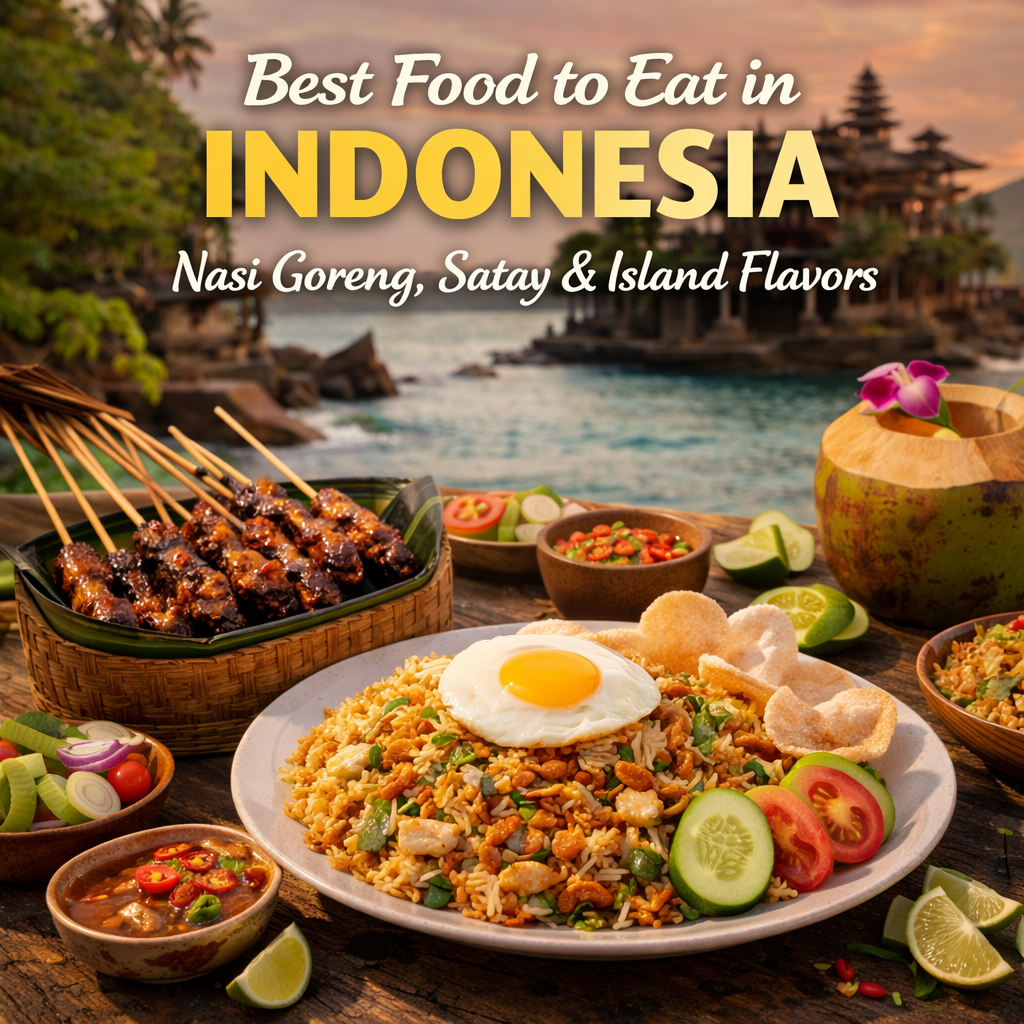
Best Food to Eat in Indonesia: Nasi Goreng, Satay and Island Flavors
Indonesia is 17,000 islands, 300 ethnic groups, and possibly the most underrated food country on Earth. From the fiery Padang restaurants of Sumatra to the sweet Javanese gudeg of Yogyakarta to the roast suckling pig of Hindu Bali — this is a country where you can eat like royalty for less than $3 a day, and every island tastes different.
Indonesian cuisine doesn’t get the international fame of Thai or Japanese food, but among food travelers who’ve been, it’s a revelation. The flavor foundations are bold: sweet soy sauce (kecap manis), shrimp paste (terasi), coconut milk, galangal, lemongrass, turmeric, and an infinite variety of sambal (chili paste). Every meal arrives with rice at the center — Indonesia consumes more rice per capita than almost any country on Earth — and the surrounding dishes range from gently sweet Javanese stews to the aggressively spiced curries of Sumatra that will leave your lips burning for an hour. This guide covers the major regional cuisines, 20 must-try dishes, the warung culture that feeds a nation, prices, and the island-by-island eating strategy that will transform your trip.
Indonesia is part of our Best Food in Asia guide covering nine top food destinations across the continent.
The Essential Indonesian Dishes Everyone Must Try
Nasi goreng — the national dish
Fried rice wok-fried with kecap manis (sweet soy sauce), shallots, garlic, chili, and usually shrimp paste, topped with a crispy fried egg (telur mata sapi — “cow’s eye egg”), served with prawn crackers (kerupuk) and sliced cucumber. It sounds simple, and it is — but the sweet-savory-smoky balance of a well-made nasi goreng, cooked over a roaring gas flame in a well-seasoned wok, is one of the most satisfying flavors in Southeast Asian food. Available at every warung, every hotel, and every street cart in the country for Rp 10,000–25,000 ($0.60–1.50 USD). The street-stall version, cooked at midnight by a roaming kaki lima (mobile cart vendor), is often the best.
Rendang — the world’s most delicious food
Beef (or sometimes chicken, water buffalo, or jackfruit) slow-cooked for hours in a thick paste of coconut milk, lemongrass, galangal, turmeric, ginger, chilies, and a dozen other spices until all the liquid evaporates and the sauce caramelizes into the meat, coating each piece in an intensely flavored, dry, dark crust. Rendang is originally Minangkabau from West Sumatra, and the proper version takes 4–8 hours to cook. It was designed to last for days without refrigeration — the spice-and-coconut coating acts as a natural preservative. CNN Travel voters named it the world’s most delicious food in 2017, and it’s hard to argue. Rp 20,000–40,000 ($1.20–2.40 USD) at Padang restaurants. The best rendang is in Bukittinggi and Padang, West Sumatra — but excellent versions are available at Padang restaurants in every Indonesian city.
Satay (sate) — the grilled skewer
Small pieces of chicken, goat, beef, pork (in non-Muslim areas), or rabbit threaded onto bamboo skewers and grilled over charcoal, served with a peanut sauce dip. Each region has its own version: sate ayam (chicken with peanut sauce — the standard), sate kambing (goat — grilled over coconut shell charcoal, served with sweet soy and raw shallot), sate Madura (from Madura island — sweeter, with a thicker peanut sauce), sate lilit (Balinese — minced seafood or pork wrapped around lemongrass sticks), and sate padang (in a yellow turmeric-curry sauce instead of peanut). Rp 15,000–35,000 ($0.90–2.10 USD) for 10 skewers.
Nasi campur — the mixed rice plate
The everyday Indonesian meal: a mound of white rice with a selection of small portions of various dishes arranged around or on top of it. You point at what you want from a glass display case at a warung — fried chicken, tempeh, sambal eggs, vegetables, rendang, whatever catches your eye — and they build your plate. It’s the Indonesian thali, and it’s how 270 million people eat most days. Rp 15,000–35,000 ($0.90–2.10 USD) depending on how many toppings you choose. The Balinese version (nasi campur Bali) is particularly elaborate, with lawar (minced meat with coconut), sate lilit, and sambal matah.
At nasi campur warungs, there’s no menu — just point at what looks good in the glass case and say “ini” (this one). Point at 3–5 dishes plus rice. The vendor will plate it, and you pay at the end. Don’t be shy about pointing at everything — the portions are small and the prices are tiny. A fully loaded plate with rice, two proteins, vegetables, sambal, and kerupuk rarely exceeds Rp 30,000 ($1.80 USD).
Nasi Padang: The Most Dramatic Meal in Southeast Asia
Padang food (from the Minangkabau people of West Sumatra) is Indonesia’s most celebrated regional cuisine — fiery, coconut-rich, and served in a style that’s pure theater. At a Padang restaurant (rumah makan Padang), you sit down and within minutes, a waiter arrives carrying a tower of 10–15 small plates stacked on their arm and forearm — a gravity-defying feat — and places them all on your table. You eat what you want. You pay only for what you eat. Untouched plates go back.
The essential Padang dishes
Rendang — the crown jewel (covered above). Gulai — a thinner, soupier curry than rendang, usually with chicken (gulai ayam), jackfruit (gulai nangka), or fish (gulai ikan). Rich with coconut cream and turmeric. Dendeng balado — thin, dried beef strips fried crispy and tossed in a fresh red chili sambal. Fiery and addictive. Gulai otak — brain in coconut curry (adventurous but creamy and mild). Ayam pop — Padang-style chicken, poached then lightly fried until pale golden and tender, served with a green chili sambal. Sambal hijau — the green chili sambal that’s Padang’s signature condiment: green chilies, shallots, and lime. Deceptively spicy.
Daun singkong — cassava leaves slow-cooked in coconut milk until silky. Telur dadar — thick, spiced omelet. Perkedel — fried potato fritters. Sayur nangka — young jackfruit in curry. Together, a full Padang spread offers 15+ dishes for one person, and the bill rarely exceeds Rp 40,000–60,000 ($2.40–3.60 USD) even if you sample aggressively.
Padang restaurants exist in every city in Indonesia — they’re the country’s most popular restaurant format. Sederhana and Garuda are the two most widespread chains with consistent quality. In Jakarta, Sari Ratu and Pagi Sore are highly regarded. In Padang itself, Lamun Ombak and Pagi Sore are institutions. Padang food is always halal — no pork.
Javanese Cuisine: Sweet, Complex and Soul-Warming
Java — Indonesia’s most populated island and cultural heartland — produces food that’s sweeter, milder, and more nuanced than fiery Sumatran cooking. Javanese cuisine uses palm sugar (gula Jawa), sweet soy sauce (kecap manis), and tamarind heavily, creating a flavor profile that’s warm, slightly sweet, and deeply comforting. Central Javanese food (Yogyakarta, Solo) is the sweetest; East Javanese food (Surabaya) is spicier and more robust.
Gudeg — Yogyakarta’s sweet jackfruit stew
Young jackfruit slow-cooked for hours in coconut milk, palm sugar, and teak leaves (which give it a dark reddish-brown color) until tender and sweet. Served with rice, chicken (ayam opor or ayam kampung), a hard-boiled egg in coconut sauce, krecek (spiced beef skin), and sambal. It’s sweet, savory, and unlike anything else in Southeast Asian cuisine. The legendary gudeg is at Gudeg Yu Djum and Gudeg Bu Tjitro in Yogyakarta — both open since the 1920s. Rp 15,000–30,000 ($0.90–1.80 USD). Some gudeg stalls open at 4 AM and sell out by 8 AM — set an alarm.
Rawon — the black beef soup of East Java
A pitch-black beef soup colored by kluwek (pangium nut) — a mildly toxic nut that must be fermented before use, which gives rawon its inky color and unique, earthy, slightly nutty flavor. The beef is slow-braised until falling apart. Served with rice, bean sprouts, salted egg, and sambal. There’s nothing else like it in the world — the kluwek gives it a depth that’s impossible to describe. A Surabaya and East Java specialty. Rp 20,000–40,000 ($1.20–2.40 USD).
Soto — Java’s noodle soup universe
Soto ayam — the most common: a turmeric-yellow chicken broth with shredded chicken, glass noodles, rice vermicelli, bean sprouts, lime, and crispy shallots. Every city has its own soto: soto Lamongan (East Java — with koya, a crumbled prawn cracker powder), soto Betawi (Jakarta — rich with coconut milk and beef), soto Kudus (Central Java — buffalo meat), soto Bandung (West Java — with radish and clear broth). It’s Indonesia’s most diverse dish — a different soto in every city. Rp 12,000–30,000 ($0.72–1.80 USD).
More Javanese essentials
Nasi liwet — rice cooked in coconut milk with chicken, egg, and vegetables, served from a communal banana-leaf-lined pot. A Solo (Surakarta) specialty, traditionally eaten for supper. Tahu dan tempe bacem — tofu and tempeh braised in sweet soy and galangal, then deep-fried. Pecel — blanched vegetables (spinach, bean sprouts, long beans) with a peanut-and-chili sauce. Rujak — fresh tropical fruit salad dressed with a spicy palm sugar and shrimp paste sauce — sweet, sour, spicy, funky.
Balinese Food: Hindu Island, Unique Flavors
Bali is the only Hindu-majority island in Muslim-majority Indonesia, and its food reflects that difference. Pork is celebrated here (babi guling is the island’s most famous dish), temple offerings involve elaborate food preparations, and the flavor profile is distinct — more fresh herbs, more base gede (the foundational Balinese spice paste), and more raw sambal matah than you’ll find in Java or Sumatra.
Babi guling — Balinese roast suckling pig
A whole pig stuffed with a paste of turmeric, coriander, lemongrass, galangal, and chili, spit-roasted over wood fire until the skin turns crispy, crackly gold and the meat is moist and fragrant. Served with rice, lawar, sate lilit, and several types of sambal. Ibu Oka in Ubud (famously visited by Anthony Bourdain) is the most tourist-famous, but Babi Guling Pak Malen in Seminyak and Warung Babi Guling Sanur are considered better by locals. Rp 40,000–70,000 ($2.40–4.20 USD) for a loaded plate.
Lawar — the Balinese chopped salad
A ritual dish: finely chopped vegetables (long beans, coconut, jackfruit) mixed with minced meat or pork, grated coconut, spices, and sometimes fresh pig blood (lawar merah). The blood version is ceremonial and deeply traditional. The non-blood version (lawar putih — “white lawar”) is milder and more accessible. Both are intensely flavored, served at room temperature, and available at every Balinese warung.
Sambal matah — Bali’s raw sambal
A raw, uncooked sambal of thinly sliced shallots, lemongrass, bird’s eye chilies, lime juice, and coconut oil. Fresh, bright, and aromatic rather than the cooked, roasted intensity of Javanese or Sumatran sambals. It’s Bali’s signature condiment and pairs with everything, especially grilled fish and babi guling. Once you try sambal matah, you’ll want it on everything.
Bebek betutu — slow-cooked ceremonial duck
A whole duck rubbed inside and out with base gede (a complex paste of 15+ spices including turmeric, ginger, galangal, shallots, garlic, chilies, candlenuts, and shrimp paste), wrapped in banana leaves and areca bark, then slow-cooked for 6–12 hours over smoldering rice husks and coconut shell. The result is incredibly tender, deeply spiced meat with an aromatic complexity that takes a full day to develop. It’s ceremonial food — prepared for temple festivals and special occasions. Tourist restaurants serve it daily, but the best versions are at warung ceremonies. Rp 50,000–100,000 ($3–6 USD).
Indonesian Street Food: Kaki Lima and Night Markets
Indonesian street food culture revolves around the kaki lima — a wheeled cart (literally “five legs” — three on the cart, two on the vendor) that roams neighborhoods, often at night, announcing its presence with a distinctive sound: the bakso man taps a bowl with a spoon, the sate guy fans his charcoal grill, the siomay vendor shouts “siomaaaaay.” You hear it, you come out, you eat.
Bakso — Indonesia’s meatball soup obsession
Indonesia is wildly obsessed with bakso — beef meatball soup with noodles, tofu, fried wontons, bean sprouts, and a clear beef broth. The meatballs are dense, bouncy, and seasoned with garlic and pepper. Bakso carts are everywhere — from dawn to midnight. Former president Jokowi is a famous bakso devotee, and the country consumes an estimated 1.5 billion servings per year. The best bakso has handmade, coarse-textured meatballs (not factory-smooth). Rp 10,000–20,000 ($0.60–1.20 USD). Some versions include a giant meatball the size of a tennis ball, stuffed with egg and wrapped in noodles (bakso beranak — “pregnant meatball”).
Martabak — the king of Indonesian street desserts
Martabak manis (sweet martabak) is a thick, fluffy pancake cooked on a round griddle, filled with chocolate, peanuts, cheese, condensed milk, or any combination thereof, folded in half and slathered with butter. It’s insanely rich, purely indulgent, and one of the best street desserts in Southeast Asia. Martabak telur (savory martabak) is a crispy, fried stuffed pancake filled with egg, minced meat, and green onions. Both are evening street food — the carts appear after sunset. Rp 20,000–50,000 ($1.20–3 USD).
Gorengan — the fried snack basket
Every Indonesian neighborhood has a gorengan cart — a deep-frying station selling an assortment of battered, fried snacks: tahu goreng (fried tofu), tempe goreng (fried tempeh), pisang goreng (fried banana — Indonesia’s most popular snack), bakwan (vegetable fritter with cabbage and carrot), and ubi goreng (fried sweet potato). All dipped in a simple sambal or green chili. Rp 1,000–3,000 per piece ($0.06–0.18 USD). You eat them hot, standing at the cart, while they’re still crackling from the oil.
Pecel lele — the crispy catfish
Deep-fried whole catfish, golden and crispy, served with rice, sambal (usually a devastating raw chili sambal), and lalapan (raw vegetables: cabbage, basil, cucumber). It’s one of the most popular late-night street foods in Java — pecel lele stalls set up around 6 PM and stay open until 2 AM. The fish is butterflied, dusted in turmeric-seasoned flour, and fried until shattering crispy. Rp 12,000–25,000 ($0.72–1.50 USD) with rice.
Indonesian street food follows a daily rhythm: breakfast carts (bubur ayam, nasi uduk, lontong sayur) from 5–9 AM. Lunch warungs from 10 AM–2 PM. Gorengan and snack carts from 2–6 PM. Night carts (bakso, martabak, nasi goreng, sate) from 6 PM onward. The freshest, best food is always during peak hours — eat when the locals eat.
The Sambal Universe: Indonesia’s 300+ Chili Pastes
If there’s one thing that defines Indonesian cuisine above all else, it’s sambal. Every meal includes sambal. Every region has its own versions. There are estimated to be over 300 distinct sambal recipes across the archipelago. Understanding sambal is understanding Indonesia.
Sambal terasi — the most common: red chilies ground with shrimp paste (terasi), tomato, shallots, and lime. Pungent, spicy, umami-rich. Sambal oelek — the simplest: raw ground red chilies with salt and vinegar. Pure heat. Sambal matah — Bali’s raw shallot-lemongrass sambal (covered above). Sambal bajak — a Javanese cooked sambal with candlenuts, palm sugar, and shrimp paste, fried until dark and caramelized. Sweeter, more complex. Sambal dabu-dabu — from Manado (North Sulawesi): a fresh salsa-like sambal with tomatoes, chilies, shallots, and lime. Bright and fresh, served with grilled fish.
Sambal hijau — green chili sambal from Padang, deceptively fiery. Sambal kecap — the mildest: sweet soy sauce with sliced chilies, shallots, and lime. A dipping sauce for sate and grilled meats. Sambal mangga — green mango sambal, sour and spicy, served with seafood.
Warung Culture: How 270 Million Indonesians Actually Eat
The warung is the backbone of Indonesian food culture. It’s not a restaurant in the Western sense — it’s a small, family-run eatery that might be a permanent building with 4–6 tables, a roadside stall with plastic chairs, or literally someone’s front porch with a few dishes in a glass case. Warungs specialize: a warung nasi campur, a warung soto, a warung bakso. The food is made by one person (usually a woman — the ibu who runs the warung) and it’s almost always better than anything at a proper restaurant, because she’s been making the same 5–10 dishes every day for 20 years.
Eating at warungs is not “cheap eating” — it’s how Indonesia eats. From construction workers to executives, everyone has their favorite warung. Prices are lowest here because overhead is minimal. The food is freshest here because turnover is constant. And the human connection is warmest here because the ibu remembers what you ordered yesterday.
At nasi campur warungs, just point and say “ini” (this). At specialized warungs (bakso, soto), there’s usually one main dish with optional extras. Prices are rarely displayed — they’re always fair, but if nervous, ask “berapa?” (how much?) before ordering. Bring small bills (Rp 5,000 and 10,000) — warungs often can’t break Rp 100,000 notes. Eat with your right hand or ask for a spoon and fork (sendok dan garpu) — knives are rare.
Indonesian Drinks and Coffee Culture
Kopi tubruk — Indonesian-style coffee: finely ground coffee mixed directly with hot water and sugar in a glass, with the grounds settling to the bottom. You drink around the grounds. It’s strong, sweet, and the daily ritual of 270 million people. Rp 3,000–8,000 ($0.18–0.48 USD) at a warung kopi.
Indonesian specialty coffee is world-class. Sumatra Mandheling (earthy, low acid), Sulawesi Toraja (complex, full-bodied), Java (smooth, balanced), and Flores (chocolate notes) are all excellent single-origin coffees. Bali’s Ubud and Jakarta’s Menteng neighborhood have thriving third-wave coffee scenes. Kopi luwak (civet coffee) is famous but controversial — wild-sourced is rare and ethical, farmed versions involve caged animals. Skip it unless you can verify the source. For more on Indonesia’s coffee in global context, see our Best Coffee Around the World guide.
Es teh manis — sweet iced tea, served at every meal. The default beverage of Indonesia. Rp 3,000–5,000. Es cendol/dawet — shaved ice with green rice flour jelly worms, coconut milk, and palm sugar syrup. The best tropical dessert drink. Rp 5,000–15,000. Es jeruk — fresh squeezed orange or lime juice. Jamu — traditional herbal drinks sold by roaming vendors (jamu gendong) carrying bottles on their backs. Turmeric, ginger, tamarind, and honey are common bases. It’s folk medicine meets refreshment.
Bintang is Indonesia’s beer (a lager, perfectly drinkable, beloved by every Bali tourist). Available in non-Muslim areas. Rp 25,000–40,000 ($1.50–2.40 USD) at warungs, more at beach bars.
Best Food Cities in Indonesia
🏛️ Yogyakarta — Java’s food soul
The cultural capital of Java, with the most distinctive Javanese food and the best street food scene on the island. Affordable even by Indonesian standards.
🌆 Jakarta — Every Indonesian cuisine in one city
The capital has a Padang restaurant on every block, Javanese warungs, Sundanese restaurants, Manadonese grills, and a booming modern food scene.
🌺 Bali (Ubud & Seminyak) — Local meets global
Bali’s food scene blends traditional Balinese cuisine with an international wellness/foodie culture. More expensive than Java but more diverse.
🌶️ Padang / Bukittinggi — The source
The origin of rendang and the Padang restaurant tradition. West Sumatra’s food is the gold standard — what you eat in Jakarta Padang restaurants is good, but here it’s transcendent.
🏙️ Bandung — Sundanese food capital
West Java’s Sundanese cuisine is distinct: lighter, more vegetable-centric, and centered around raw vegetables with sambal (lalapan). Bandung’s restaurant scene is also excellent value.
For the definitive global street food ranking — including Jakarta and Yogyakarta — see Best Street Food Cities in the World.
Complete Indonesian Dish Guide: Prices, Regions and Must-Try Rating
| Dish | Type | Region | Price (Rp / USD) | Spice | Must-Try |
|---|---|---|---|---|---|
| Nasi Goreng | Fried rice | Nationwide | 10–25K / $0.60–1.50 | 🌶️ Mild-med | ★★★★★ |
| Rendang | Curry (dry) | W. Sumatra | 20–40K / $1.20–2.40 | 🌶️🌶️ Med-hot | ★★★★★ |
| Nasi Padang (meal) | Multi-dish | W. Sumatra | 25–60K / $1.50–3.60 | 🌶️🌶️🌶️ Hot | ★★★★★ |
| Satay (10 skewers) | Grilled | Nationwide | 15–35K / $0.90–2.10 | 🌶️ Mild | ★★★★★ |
| Babi Guling | Roast pork | Bali | 40–70K / $2.40–4.20 | 🌶️🌶️ Medium | ★★★★★ |
| Gado-Gado | Salad | Java | 12–25K / $0.72–1.50 | 🌶️ Mild | ★★★★★ |
| Gudeg | Stew | Yogyakarta | 15–30K / $0.90–1.80 | None (sweet) | ★★★★★ |
| Soto Ayam | Soup | Java | 12–30K / $0.72–1.80 | 🌶️ Mild | ★★★★★ |
| Bakso | Meatball soup | Nationwide | 10–20K / $0.60–1.20 | 🌶️ Mild | ★★★★☆ |
| Rawon | Black soup | E. Java | 20–40K / $1.20–2.40 | 🌶️ Mild | ★★★★★ |
| Mie Goreng | Fried noodles | Nationwide | 10–25K / $0.60–1.50 | 🌶️ Mild-med | ★★★★☆ |
| Nasi Campur | Mixed rice | Nationwide | 15–35K / $0.90–2.10 | Varies | ★★★★★ |
| Martabak Manis | Dessert | Nationwide | 20–50K / $1.20–3 | None | ★★★★☆ |
| Pecel Lele | Fried fish | Java | 12–25K / $0.72–1.50 | 🌶️🌶️ Med-hot | ★★★★☆ |
| Bebek Goreng | Crispy duck | Java/Bali | 25–50K / $1.50–3 | 🌶️🌶️ Medium | ★★★★☆ |
| Ayam Goreng | Fried chicken | Nationwide | 12–30K / $0.72–1.80 | 🌶️ Mild | ★★★★☆ |
| Tempeh Goreng | Fried tempeh | Java | 3–8K / $0.18–0.48 | None | ★★★★☆ |
| Nasi Uduk | Coconut rice | Jakarta | 10–25K / $0.60–1.50 | 🌶️ Mild | ★★★★☆ |
| Es Cendol | Dessert drink | Java | 5–15K / $0.30–0.90 | None | ★★★★☆ |
| Pisang Goreng | Snack | Nationwide | 2–5K / $0.12–0.30 | None | ★★★★☆ |
How to Eat Well in Indonesia on Any Budget
Budget: under Rp 60,000/day ($3.60 USD)
Breakfast: bubur ayam from a cart (Rp 8,000). Lunch: nasi campur at a warung — rice, chicken, tempeh, veg, sambal (Rp 18,000). Dinner: nasi goreng from a kaki lima (Rp 12,000). Snacks: pisang goreng and gorengan (Rp 5,000). Drinks: kopi tubruk and es teh manis (Rp 8,000). Total: Rp 51,000 ($3.06). This is genuinely how many Indonesians eat, and the food is outstanding.
Mid-range: Rp 100,000–250,000/day ($6–15 USD)
Breakfast: nasi uduk or bubur at a sit-down warung (Rp 15,000–25,000). Lunch: full Padang spread (Rp 35,000–60,000). Dinner: babi guling or bebek goreng at a proper restaurant (Rp 40,000–80,000). Coffee at a third-wave cafe (Rp 25,000–40,000). Dessert: martabak manis (Rp 25,000). In Bali, add 50–100% to these prices. In Java, this budget is luxurious.
High-end: Rp 500,000+/day ($30+ USD)
Indonesia’s fine dining is excellent and still a fraction of global prices. Locavore in Ubud (modern Indonesian, Asia’s 50 Best), GIA in Jakarta, Room4Dessert in Ubud (dessert tasting menu). A tasting menu at Locavore: Rp 1,500,000–2,500,000 ($90–150 USD) — comparable to a $300+ experience in New York. Even high-end Indonesian food is a bargain by global standards.
Explore More Asian Cuisines
Indonesia is one of nine countries in our Best Food in Asia guide. The archipelago connects to its neighbors through centuries of trade, migration, and shared ingredients:
🇲🇾 Best Food to Eat in Malaysia — rendang, satay, and nasi lemak cross the border freely. Malaysian and Indonesian food are cousins (don’t tell either side they’re the same — the rivalry is fierce).
🇵🇭 Best Food to Eat in the Philippines — the Malay-Austronesian food connection runs from the Philippines through Indonesia to Malaysia. Similar ingredients (coconut, vinegar, fermented fish), very different results.
🇹🇭 Best Food to Eat in Thailand — satay, coconut curries, and lemongrass-galangal bases connect the two cuisines. Indonesia’s are earthier and sweeter; Thailand’s are brighter and more sour.
🇮🇳 Best Food to Eat in India — Indian traders brought curry spices, roti, and martabak to Indonesia centuries ago. The Indian-Indonesian connection runs through every spice in the rendang paste.