Sugerowany rozmiar: 1200×630px
Best Food to Eat in Croatia: Coastal Seafood and Balkan Flavors
Croatia is two food countries pretending to be one. On the Adriatic coast, the cooking is Mediterranean: olive oil, grilled fish, prosciutto, risotto, and wine that tastes like it could have come from across the water in Italy. Inland, everything changes. Zagreb and Slavonia are Central European: heavier, paprika-spiced, built on pork, cabbage, and stews that stick to your ribs through a continental winter. Both sides are excellent. Together, they make Croatia one of the most underrated food destinations in Europe.
The Dalmatian coast has been drawing food travelers for years, quietly producing olive oil that wins international competitions, truffle pasta in Istria that rivals anything in Piedmont, and fresh seafood grilled over charcoal at seaside konobas where the fish was swimming that morning. But the inland half of the story is less known and equally compelling: Slavonia’s kulen sausage, Zagreb’s štrukli, the game and mushroom traditions of Gorski Kotar, and a wine scene that’s finally getting the global recognition it deserves. This guide covers both coasts and both kitchens, 20 must-try dishes, the konoba culture, regional differences, prices, and why Istria might be the next great European food region.
Croatia is part of our Best Food in Europe guide covering nine food destinations across the continent.
Dalmatian Coast: Seafood, Peka and the Konoba Tradition
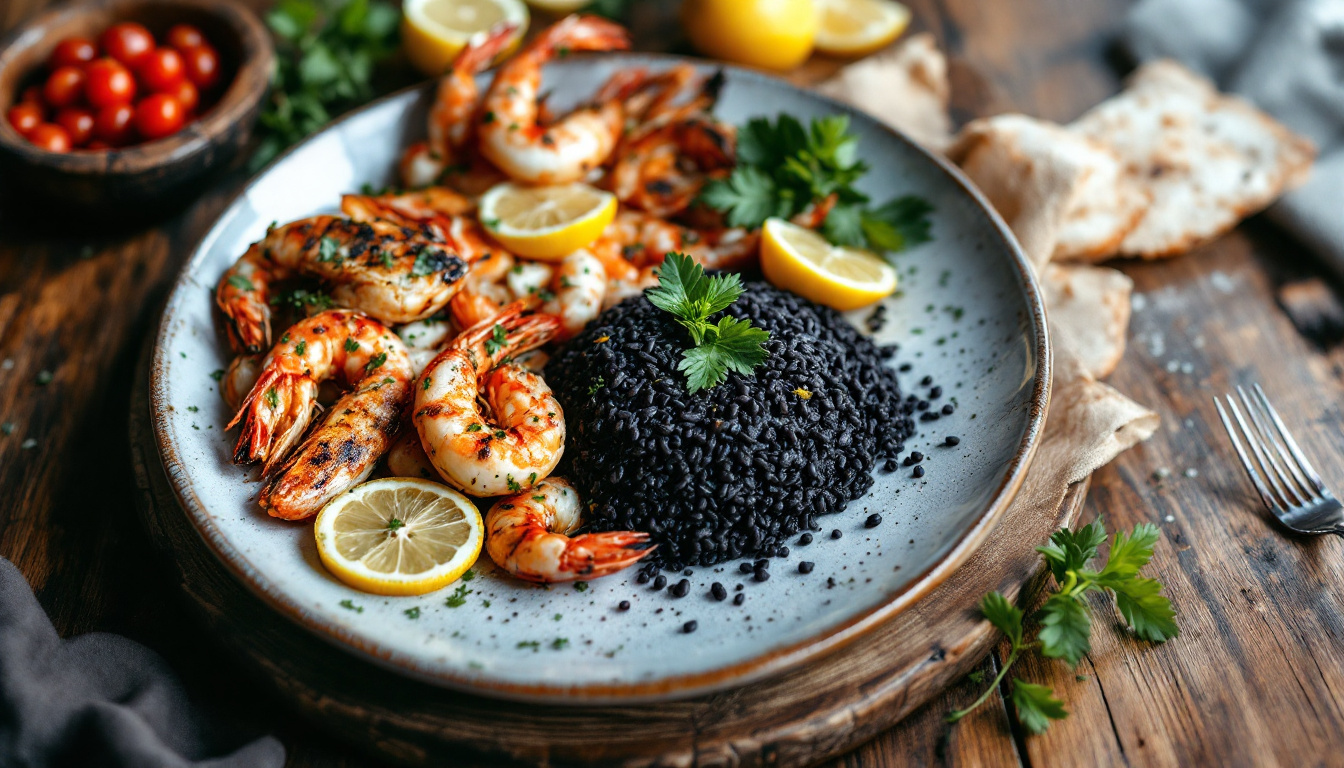
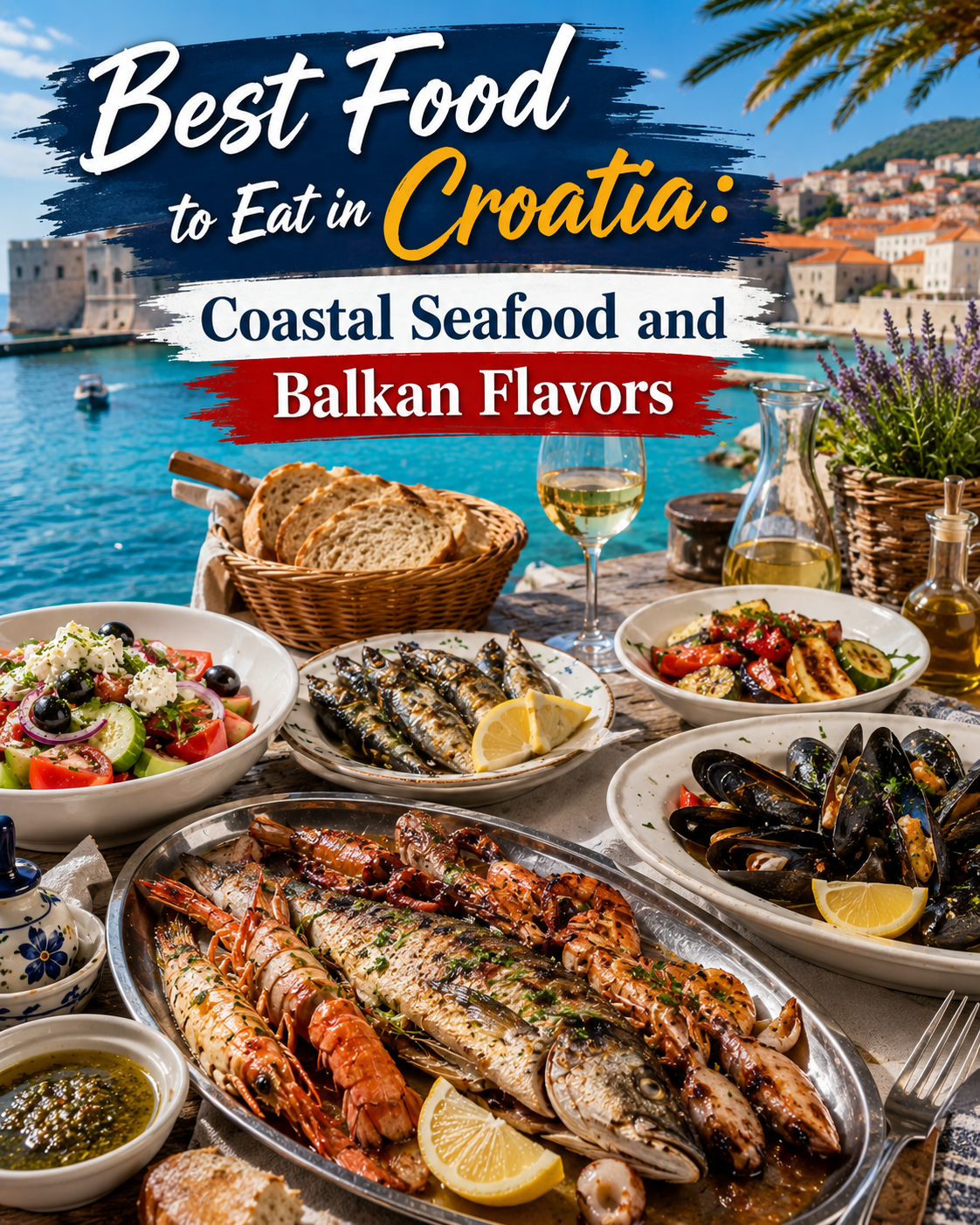
Dalmatia runs from Zadar south through Split to Dubrovnik, and its food is pure Mediterranean: grilled fish, octopus, olive oil, herbs, and wine. The cooking is simple because the ingredients are exceptional. A fish grilled whole over charcoal at a harbour-side konoba, dressed with nothing but local olive oil, garlic, and parsley, is as good as seafood gets in Europe. The secret weapon is the Adriatic itself: cleaner, less overfished, and cooler than much of the Mediterranean, producing fish with firmer texture and cleaner flavour.
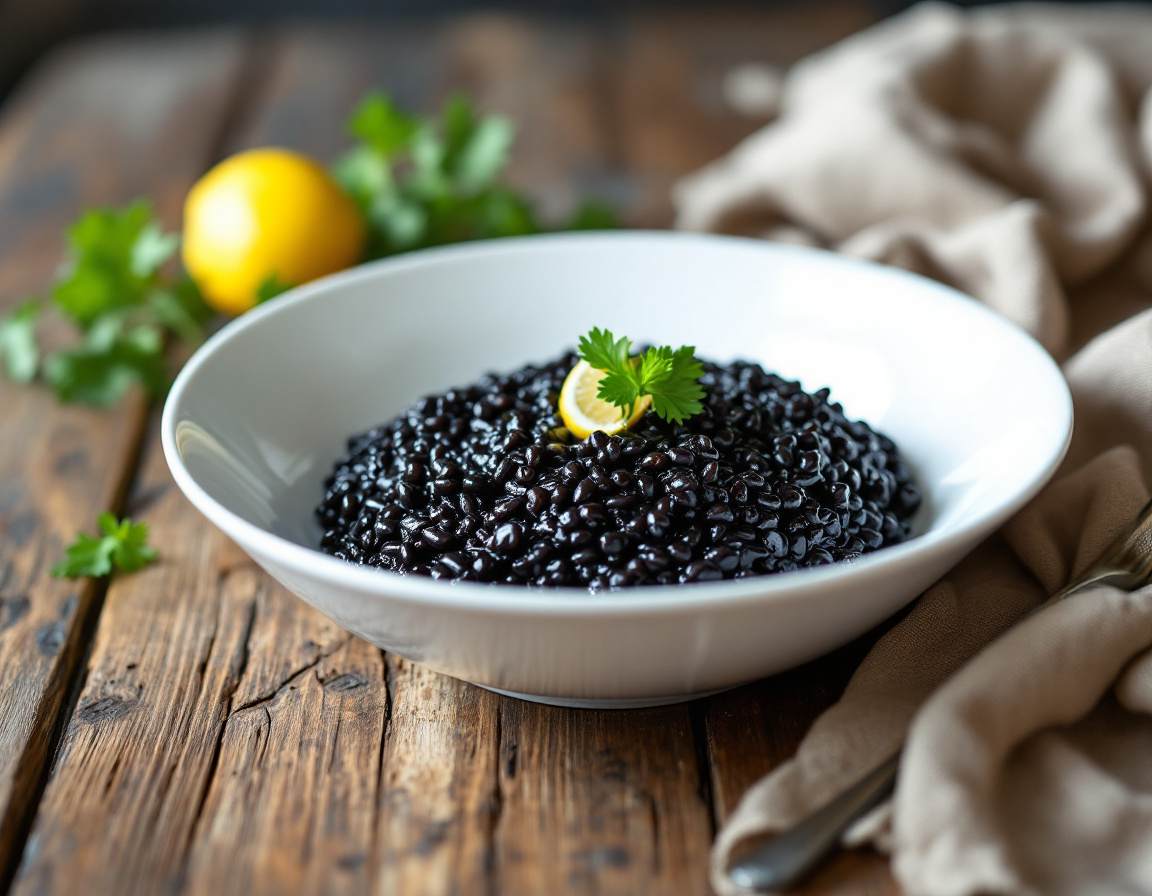
Crni rižot (black risotto)
Adriatic rice cooked with cuttlefish (or squid), coloured jet-black by the cuttlefish’s own ink, flavoured with garlic, white wine, and olive oil. The ink gives the risotto a deep, briny, slightly metallic flavour that’s unlike any other rice dish. Your teeth and lips turn temporarily black, which is part of the charm. The rice should be loose and slightly soupy (Croatian risotto is wetter than Italian risotto). Served at every coastal konoba. €10-18. Split and the islands do it best.
Peka (ispod peke): Croatia’s signature slow cook
The most iconic Croatian cooking method. Octopus, veal, or lamb is placed in a round metal dish with potatoes, onions, tomatoes, garlic, rosemary, and olive oil. A heavy domed lid (the peka, or sač) is placed on top and buried under hot coals and embers. It slow-roasts for 2-3 hours, the steam and smoke trapped inside, until the meat is fork-tender and the potatoes have absorbed all the juices and herbs. Octopus peka (hobotnica ispod peke) is the coastal version; veal peka (teletina ispod peke) is the inland classic.
Critical detail: peka must be ordered 2-3 hours in advance at most konobas, since it takes that long to cook. Don’t show up at dinner and expect it. Call ahead or order it when you arrive at lunch, then eat it for dinner. Minimum two people. €15-25 per person. When done right, peka is the single best thing you’ll eat in Croatia.
A konoba is a traditional Dalmatian tavern, originally a stone cellar where families stored wine and olive oil. Today, konobas are the best restaurants on the coast: small, family-run, with stone walls, a limited menu of whatever’s fresh, house wine from the owner’s vineyard, and prices significantly lower than the tourist-facing restaurants on the main promenade. Always eat at a konoba over a “restoran” in Dalmatia. Ask locals for their favourite, it’s never the one with the English menu on the harbour.
Pašticada: Dalmatia’s slow-braised beef
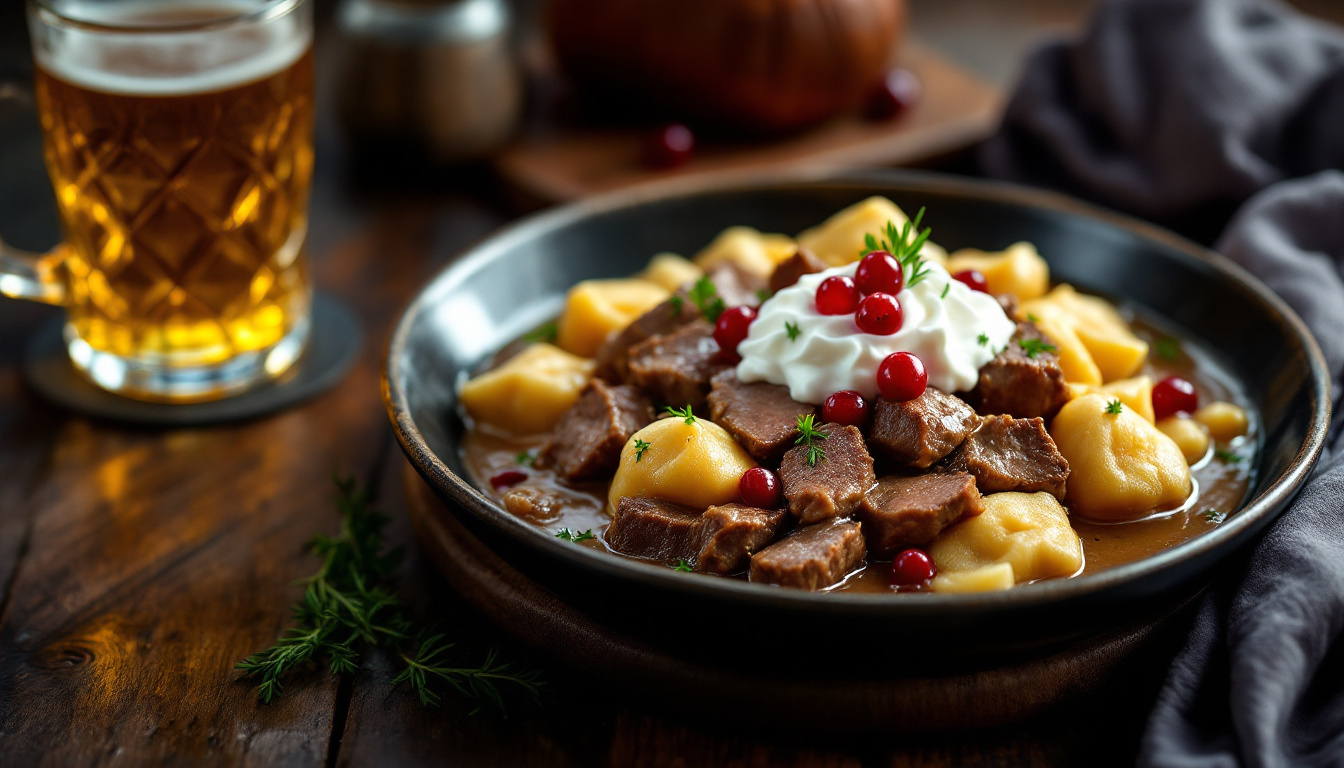
A special-occasion dish from Split and central Dalmatia: beef (usually bottom round) marinated overnight in vinegar and prošek (Dalmatian sweet wine), then slow-braised for hours with bacon, onions, carrots, prunes, and a paste of dried figs, cloves, and nutmeg. The sauce reduces into a thick, dark, sweet-savoury gravy. Served with gnocchi (njoki) that soak up the sauce. Pašticada is Croatian home cooking at its most elaborate: families have their own recipes, handed down through generations, with fierce pride in the specific proportions. €12-20. Best in Split and the islands around it.
Brudet (fish stew)
A Dalmatian fisherman’s stew: multiple types of fish and shellfish (whatever the catch produced) simmered in a tomato-based broth with olive oil, garlic, wine, and vinegar. Each layer of fish is added at a different time based on how long it takes to cook, so nothing is over or underdone. Served with polenta (palenta) to soak up the broth. The stew should be slightly sour from the vinegar, rich from the tomato, and deeply briny from the mix of fish. Every Dalmatian family claims theirs is the best. €12-18.
Istria: The Next Great European Food Region
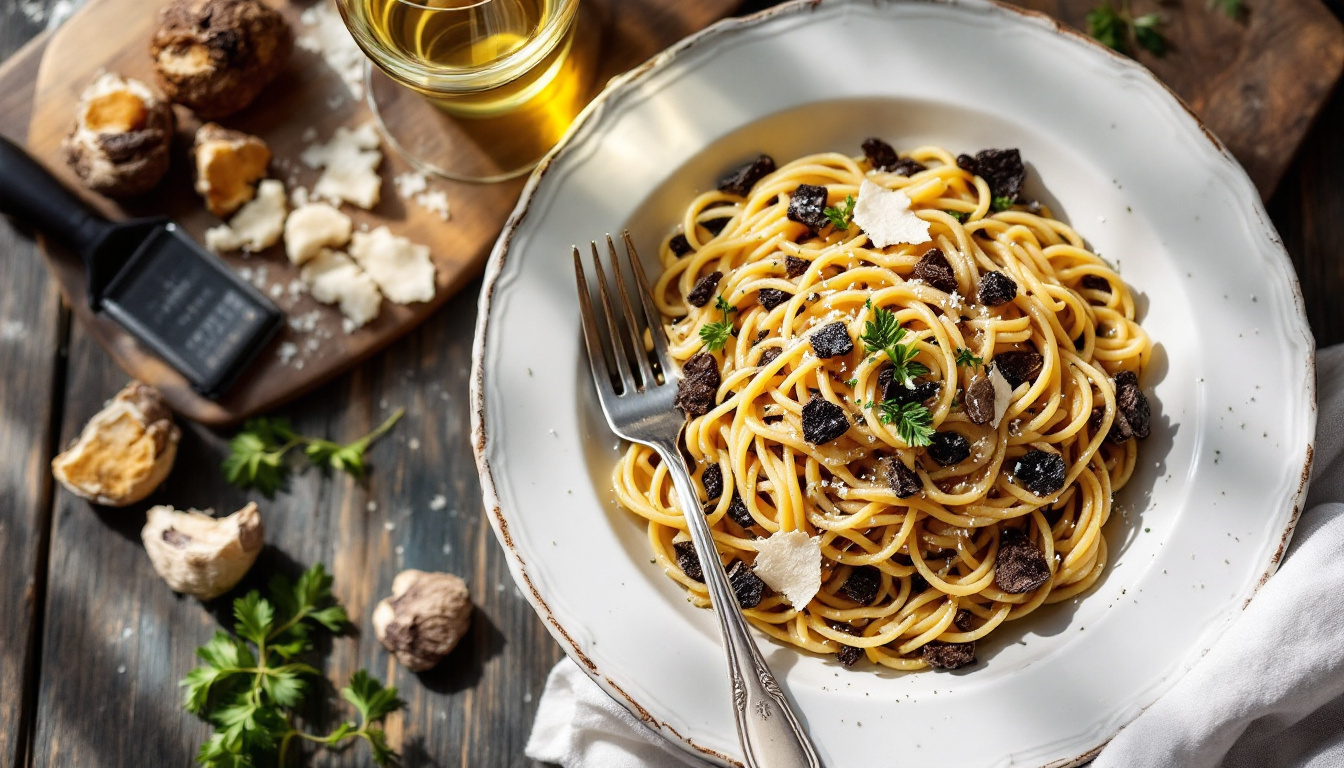
Istria, the heart-shaped peninsula in Croatia’s northwest corner, is where food travelers are increasingly heading. The region produces truffles that rival Italian Piedmont and Umbria, olive oil that consistently wins international gold medals, wine from indigenous varieties, and a food culture that blends Italian technique with Slavic heartiness. Istria was under Venetian rule for centuries, then Austrian, then Italian, and the food reflects all of it.
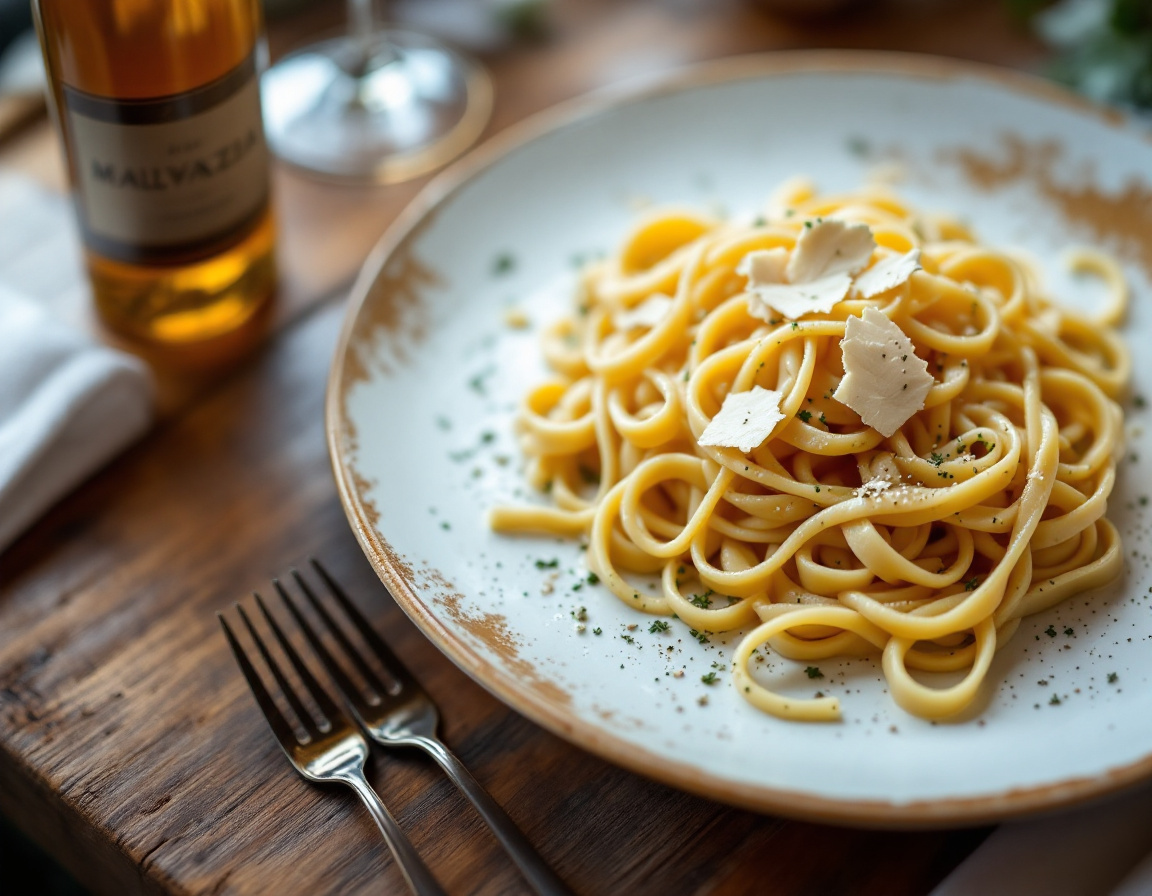
Istrian truffles
Istria’s Motovun Forest is one of Europe’s richest truffle grounds. Black truffles (tartufo nero) are available year-round, peaking in winter. White truffles (tartufo bianco), the rarer and more expensive variety, appear from September to December. In 1999, the world’s largest white truffle (1.31 kg) was found in Istria. Truffle dishes appear on every restaurant menu in the region: shaved over pasta (fuži, the local hand-rolled tube pasta), folded into omelets, mixed into cheese, and even infused into honey and chocolate.
A plate of fuži with truffles at a local konoba: €15-25 (dramatically cheaper than equivalent dishes in Alba or Perugia). For the full experience, book a truffle hunting excursion with a local hunter and their dog in the Motovun Forest (€40-80 per person, usually including a truffle lunch).
Istrian olive oil
Istrian olive oil regularly ranks among the world’s best. The region’s native varieties (buža, istarska bjelica, rožinjola) produce oils that are peppery, herbaceous, and intensely green. The annual Flos Olei guide consistently awards Istrian producers top marks. You can taste the difference immediately: drizzle Istrian oil on bread, fish, or pasta and it transforms the dish. Most Istrian restaurants proudly serve their own or a local producer’s oil. Bottles make excellent souvenirs: €10-25 for a quality 500ml bottle at the farm gate.
More Istrian essentials
Maneštra: Istria’s signature bean-and-vegetable stew, thick and hearty, sometimes with smoked pork. The Istrian equivalent of Italian minestrone but heavier and earthier. Boškarin: an indigenous Istrian ox breed, nearly extinct, now revived and served as slow-braised beef or steak. The meat is lean, deeply flavoured, and served at premium restaurants. Fritaja: an Istrian omelet with wild asparagus (in spring) or truffles (in autumn). Fuži: hand-rolled, quill-shaped pasta unique to Istria, the traditional vehicle for truffle sauce or game ragù. Pljukanci: another Istrian hand-rolled pasta, thinner and shorter than fuži.
Black summer truffle (Tuber aestivum): May-September, mild flavour, cheapest. Black winter truffle (Tuber melanosporum): November-March, intense, the cooking truffle. White truffle (Tuber magnatum): September-December, the prize, shaved raw over dishes. Zigante Tartufi in Livade is the most famous truffle shop/restaurant. The Istrian truffle days festival (Giornate del Tartufo) in autumn draws food tourists from across Europe.
Zagreb and Inland Croatia: Central European Comfort Food
Cross the Dinaric Alps from the coast and the food changes completely. Zagreb and the interior eat like Central Europeans: pork schnitzel, stuffed cabbage, strudel, and heavy stews designed for cold continental winters. The Austrian, Hungarian, and Turkish influences are visible on every menu. Prices are lower than the coast, portions are larger, and the flavours are richer and more savoury.
Štrukli: Zagreb’s signature dish
Thin sheets of dough filled with a mixture of fresh cheese (similar to cottage cheese or quark), sour cream, and eggs, then either baked (pečeni štrukli, with a golden, bubbly cheese crust) or boiled (kuhani štrukli, softer and more delicate). The baked version is more popular and more photogenic: rich, stretchy, cheesy, and deeply comforting. Available at nearly every traditional restaurant in Zagreb. La Štruk, a tiny restaurant near the Stone Gate in Zagreb’s Upper Town, is dedicated entirely to štrukli. €5-9.
Zagreb essentials
Purica s mlincima: roast turkey with mlinci (dried, crumbled flatbread that rehydrates in the turkey’s juices during roasting, becoming soft, savoury, and soaked with fat). This is Zagreb’s most traditional special-occasion dish. Zagorski štrukli: the version from the Zagorje hills north of Zagreb, often richer and served as a main course. Kremšnite (cremeschnitte): a vanilla custard slice between layers of puff pastry, dusted with powdered sugar. Zagreb’s favourite dessert, borrowed from the Austrian tradition. The best version is at Samoborska kremšnita in Samobor, a small town 20 minutes from Zagreb. Cottage cheese štrukli with walnuts and honey as dessert: a sweet version that appears on many restaurant menus.
Slavonia: Kulen, Paprika and River Fish
Slavonia is Croatia’s eastern frontier, a flat, fertile plain along the Danube and Drava rivers, with a food culture that has more in common with Hungary and Serbia than with the coast. Paprika is the defining spice (the region grows its own, similar to Hungarian paprika), pork is king, and the Danube provides freshwater fish for stews and grills.
Kulen: Slavonia’s pride
A spicy, dry-cured sausage made from minced pork, seasoned heavily with paprika and garlic, stuffed into natural casings, and smoked over beech and oak wood. It’s aged for months until firm and intensely flavoured, somewhere between a spicy salami and a nduja in character (though drier). Kulen is protected by EU PGI status, and Slavonians consider it their greatest culinary achievement. Sliced thin as an appetiser with bread, cheese, and ajvar (roasted pepper relish). The best kulen comes from the Baranja region near Osijek. €3-6 for a tasting plate at a restaurant.
Fiš paprikaš (fish paprikash)
A rich, paprika-red stew of freshwater fish (carp, catfish, pike-perch) simmered with onions, tomatoes, and a generous quantity of sweet and hot paprika. Served with home-made noodles (rezanci) or bread. It’s the Slavonian soul food, cooked outdoors in large cauldrons over open fire at gatherings, festivals, and family events. The stew should be thick, the fish tender, and the paprika flavour dominant without being overwhelmingly spicy. €10-16. Best experienced at a riverside čarda (fish restaurant) near Osijek or Vukovar.
Čobanac (shepherd’s stew)
A mixed-meat stew of pork, beef, game, and sausage, heavily spiced with paprika, slow-cooked over an open fire. It’s the inland equivalent of brudet: multiple meats in one pot, each contributing a different flavour. Slavonian men consider čobanac-making a competitive sport, with cook-offs at regional festivals. Thick, meaty, fiery from paprika. Served with bread to soak up the sauce. €10-15.
Croatian Seafood: An Adriatic Guide
The Adriatic Sea is relatively shallow, clean, and rich in variety. Croatian seafood is cooked simply because it doesn’t need much: a fresh fish on a charcoal grill with olive oil, garlic, and parsley (na gradele) is the standard and it’s consistently excellent.
How to order fish in Croatia
At most konobas, the waiter will show you the day’s catch on a tray or take you to a display case. You point at the fish you want, it’s weighed, and you’re charged by the kilo. Common species: orada (sea bream), brancin (sea bass), zubatac (dentex, the premium option), škarpina (scorpionfish, used in brudet). Wild fish costs more than farmed (€40-65/kg vs €25-35/kg). The waiter will usually recommend how it should be cooked. Almost always, the answer is na gradele (grilled). Trust the recommendation.
Buzara: the shellfish treatment
Mussels (dagnje) or scampi (škampi) cooked in a sauce of white wine, garlic, olive oil, breadcrumbs, and parsley. The breadcrumbs thicken the sauce slightly, and the wine-garlic-seafood combination creates a broth you’ll want to drink with a spoon (or mop up with bread, which is the correct approach). Škampi na buzaru is the more luxurious version; dagnje na buzaru is cheaper and equally delicious. €10-20. Available at every coastal konoba.
Blitva s krumpirom (chard with potatoes)
The universal Dalmatian side dish: Swiss chard and potatoes boiled together, drained, and dressed with olive oil and garlic. It sounds basic. It is basic. And it’s a perfect example of how Croatian coastal cooking achieves excellence through simplicity. It accompanies grilled fish at almost every meal and the quality of the olive oil used to dress it makes or breaks the dish. €3-6 as a side.
The Grill: Ćevapi and Balkan Meat Culture
Ćevapi (ćevapčići)
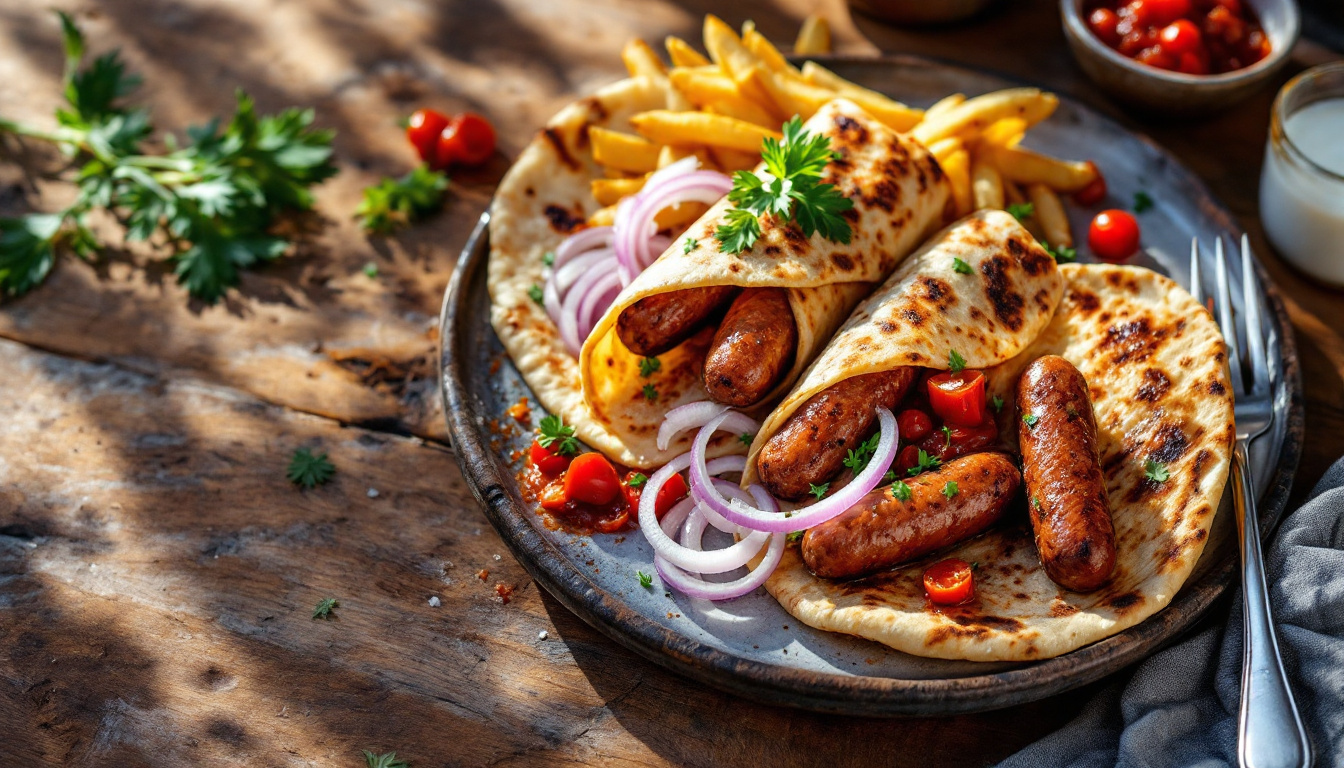
Small, finger-shaped sausages of minced meat (usually a mix of beef and pork, or sometimes lamb), seasoned with garlic, salt, pepper, and sometimes baking soda (which gives them a distinctive springy texture), grilled over charcoal. Served in a somun or lepinja bread (a soft, slightly chewy flatbread) with raw onion, kajmak (a creamy, slightly tangy dairy spread), and ajvar (roasted red pepper and eggplant relish). Ćevapi are Balkan, shared with Bosnia, Serbia, and the region, but Croatia has its own excellent tradition, especially in Zagreb and inland towns. €5-10 for a generous portion. The best ćevapi have a charcoal crust, a juicy interior, and the faintly smoky flavour that only comes from a real grill.
Pljeskavica
A large, flat, grilled patty of mixed minced meats (beef and pork, sometimes lamb), seasoned like ćevapi but formed into a burger-sized disc. Served in bread with the same accompaniments (onion, kajmak, ajvar). Think of it as the Balkan hamburger, except the meat is more densely spiced and the bread is softer. €5-9.
Ražnjići
Chunks of pork or chicken threaded on skewers and grilled over charcoal, served with onion and bread. Croatia’s version of shish kebab. Simpler than ćevapi but equally satisfying when the meat is well-seasoned and the grill is hot. €6-10.
Sarma (stuffed cabbage rolls)
Sauerkraut leaves wrapped around a filling of minced pork, rice, and spices, slow-simmered in a pot with smoked ribs and additional sauerkraut. It’s the Croatian (and broader Central/Southeastern European) equivalent of Polish gołąbki: the shared tradition of stuffing cabbage stretches from Warsaw to Zagreb to Istanbul. A winter dish, traditionally made in large quantities and reheated over several days (it improves each time). €8-12.
Croatian Cheese and Cured Meats
Paški sir (Pag Island cheese)
A hard sheep’s milk cheese from the island of Pag, aged 5-18 months, with a sharp, slightly salty, crumbly character. The sheep on Pag graze on wild sage and herbs growing on the rocky, wind-swept island, which gives the milk (and the cheese) a distinctive herbaceous flavour found nowhere else. Paški sir has won international awards competing against Manchego and Pecorino. Sold at farm gates and markets across the island. €3-6 for a tasting plate in a restaurant; €15-30 for a wedge to take home.
Dalmatinski pršut (Dalmatian prosciutto)
Dry-cured ham, salted, pressed, and air-dried in the bura (the cold, dry wind that blows from the mountains to the coast). Dalmatian pršut is leaner and slightly smokier than Italian prosciutto, with a firmer texture from the wind-drying. It’s sliced thin and served as an appetiser with Paški sir, olives, and bread, usually with a glass of local wine. Every serious konoba opens a meal this way. €5-10 for a sharing plate. The best pršut comes from the area around Drniš in the Dalmatian hinterland.
Ajvar
A relish of roasted red peppers and eggplant, slow-cooked down with garlic, vinegar, and oil into a thick, slightly sweet, smoky paste. Ajvar is the Balkan ketchup: it goes on everything, from grilled meat to bread to cheese plates. Home-made ajvar (domaći ajvar) is a September ritual in Croatian and Serbian households, when families roast hundreds of peppers and preserve jars for the winter. Every Croatian kitchen has ajvar in the fridge. €1-3 for a jar at a market.
Croatian Sweets and Desserts
Fritule: small, round donuts flavoured with lemon zest, rum, and raisins, deep-fried and dusted with powdered sugar. The Croatian equivalent of Italian zeppole or Dutch oliebollen. Sold at Christmas markets, seaside stalls, and festivals. €3-5 for a portion. Best eaten hot and freshly fried. Rožata: Dubrovnik’s crème caramel, flavoured with rose liqueur or maraschino. Silky, wobbly, and perfumed. The signature Dubrovnik dessert. €4-7.
Kremšnite: vanilla custard slices between layers of puff pastry (covered in the Zagreb section above). Palacinke: thin crêpes filled with Nutella, jam, or walnuts and honey. Stonska torta: a rich, dark cake from Ston (near Dubrovnik) made with macaroni pasta, walnuts, chocolate, and citrus. Strange-sounding but genuinely delicious, a relic of the town’s medieval trading connections. Rapska torta: an almond cake from Rab island, flavoured with maraschino cherry liqueur, made from a recipe supposedly dating to 1177 when Pope Alexander III visited.
Croatian Wine: A Renaissance Worth Exploring
Croatia grows over 130 indigenous grape varieties, many found nowhere else in the world, and the wine scene is experiencing a genuine renaissance. The country has two major wine regions: the coast (Dalmatia, Istria, islands) for big reds and aromatic whites, and the interior (Slavonia, Zagorje) for crisp whites.
Pošip (Korčula island): Croatia’s best white, mineral, citrusy, slightly honeyed. Perfect with seafood. Malvazija Istarska (Istria): fresh, floral, aromatic. Istria’s everyday white and the partner for truffle dishes. Plavac Mali (Dalmatia): a bold, tannic red related to Zinfandel (its parent grape). The best comes from the Dingač and Postup vineyards on the Pelješac Peninsula, where vines grow on impossibly steep slopes above the sea. Graševina (Slavonia): Croatia’s most-planted grape, a crisp Welschriesling, excellent value. Teran (Istria): a deeply coloured, earthy red unique to the Istrian terra rossa soil.
Prošek: a Dalmatian dessert wine made from dried grapes (passito-style), sweet, golden, and served with cheese or almond cakes. Not to be confused with Prosecco (Croatia and Italy have had legal disputes about the name). A bottle: €15-40.
Wine at Croatian restaurants is excellent value: a bottle of quality local wine runs €15-35, and house wine by the carafe is €8-15 per litre.
Best Food Cities and Islands in Croatia
🏰 Dubrovnik
Spectacular setting, excellent seafood, but the most expensive city in Croatia. Eat inside the walls for the atmosphere; eat in Gruž harbour or Lapad for better value.
🏛️ Split
Dalmatia’s food capital: the widest variety on the coast, excellent konobas hidden in Diocletian’s Palace alleys, and the best pašticada in Croatia.
🍄 Istria (Rovinj, Pula, Motovun, Buje)
Croatia’s food epicentre: truffles, olive oil, wine, prosciutto, and a density of excellent restaurants unmatched anywhere else in the country.
🏙️ Zagreb
The inland capital: štrukli, ćevapi, Central European comfort food, a booming modern restaurant scene, and the Dolac market (Zagreb’s “belly”).
🏝️ Hvar, Korčula, Vis (Islands)
Each island has its own food identity, shaped by isolation and microclimate. Hvar is lavender and wine. Korčula is Pošip wine and slow food. Vis is the most unspoiled and gastronomically authentic.
🌶️ Osijek / Slavonia
Croatia’s eastern frontier: river fish, paprika, kulen, and a food culture closer to Hungary and Serbia than to the coast.
Complete Croatian Dish Guide: Prices, Regions and Must-Try Rating
| Dish | Type | Region | Price (€ / USD) | Must-Try |
|---|---|---|---|---|
| Peka (octopus/veal) | Slow roast | Coast/Inland | €15-25 pp / $16.50-27.50 | ★★★★★ |
| Crni rižot | Risotto | Dalmatia | €10-18 / $11-19.80 | ★★★★★ |
| Ćevapi | Grilled meat | Inland/Zagreb | €5-10 / $5.50-11 | ★★★★★ |
| Istrian truffle pasta | Pasta | Istria | €15-25 / $16.50-27.50 | ★★★★★ |
| Pršut + Paški sir | Appetiser | Dalmatia/Pag | €5-12 / $5.50-13.20 | ★★★★★ |
| Pašticada | Stew | Dalmatia | €12-20 / $13.20-22 | ★★★★★ |
| Brudet | Fish stew | Dalmatia | €12-18 / $13.20-19.80 | ★★★★★ |
| Štrukli | Pastry | Zagreb | €5-9 / $5.50-9.90 | ★★★★★ |
| Grilled whole fish | Seafood | Coast | €12-25 / $13.20-27.50 | ★★★★★ |
| Buzara (mussels/scampi) | Seafood | Coast | €10-20 / $11-22 | ★★★★★ |
| Kulen | Cured meat | Slavonia | €3-6 / $3.30-6.60 | ★★★★★ |
| Fiš paprikaš | Fish stew | Slavonia | €10-16 / $11-17.60 | ★★★★☆ |
| Soparnik | Pie | Dalmatia | €3-7 / $3.30-7.70 | ★★★★☆ |
| Maneštra | Stew | Istria | €7-12 / $7.70-13.20 | ★★★★☆ |
| Sarma | Stuffed cabbage | Inland | €8-12 / $8.80-13.20 | ★★★★☆ |
| Blitva s krumpirom | Side dish | Coast | €3-6 / $3.30-6.60 | ★★★★☆ |
| Fritule | Dessert | Coast | €3-5 / $3.30-5.50 | ★★★★★ |
| Rožata | Dessert | Dubrovnik | €4-7 / $4.40-7.70 | ★★★★☆ |
| Pljeskavica | Grilled meat | Inland | €5-9 / $5.50-9.90 | ★★★★☆ |
| Kremšnite | Dessert | Zagreb/Samobor | €3-5 / $3.30-5.50 | ★★★★☆ |
How to Eat Well in Croatia on Any Budget
Prices here are 2026, in euros: Croatia joined the eurozone in January 2023, so the kuna is gone and €1 was worth roughly $1.09 through 2026. Dubrovnik and Hvar sit at the top of the range; the mainland interior and smaller islands run noticeably cheaper.
Budget: under €25/day ($27.50 USD)
Breakfast: bakery burek (flaky pastry with cheese or meat) and coffee (€3-5). Lunch: ćevapi or pljeskavica with bread and ajvar (€5-10). Dinner: konoba with a simple grilled fish or risotto and house wine (€12-18). Snack: fritule or oblatne (wafers) (€2-4). This is doable on the mainland and smaller islands. In Dubrovnik or Hvar, add 30-50%.
Mid-range: €35-70/day ($38.50-77 USD)
Breakfast: market visit + café (€5-8). Lunch: konoba with appetiser (pršut and cheese) and a main (€15-25). Dinner: seafood restaurant or peka (ordered ahead) with local wine (€20-35). Dessert: rožata or fritule (€4-6). This budget gets you excellent konoba dining, peka, and quality local wine at every meal.
High-end: €80+/day ($88+ USD)
Croatia’s fine dining is growing rapidly. Pelegrini in Šibenik (Michelin-starred, creative Dalmatian), Noel in Zagreb (contemporary Croatian), Monte in Rovinj (Istrian fine dining with Adriatic views), LD Restaurant in Korčula. A tasting menu: €80-150 per person. Istrian truffle menus at premium restaurants: €50-80. Even at the top end, Croatia is significantly cheaper than equivalent experiences in Italy or France.
Explore More European and Mediterranean Cuisines
Croatia is one of nine countries in our Best Food in Europe guide. Croatian food connects to its neighbours through geography, history, and shared Mediterranean culture:
🇮🇹 Best Food to Eat in Italy: Istrian and Dalmatian food is deeply Italian-influenced. Venetian rule left risotto, prosciutto, pasta, and olive oil. A Croatia-Italy food trip along the Adriatic is one of Europe’s best eating routes.
🇬🇷 Best Food to Eat in Greece: both countries share Adriatic and Mediterranean seafood traditions, olive oil culture, and the simple-grilled-fish-by-the-sea experience. Greek food is the eastern cousin of Dalmatian food.
🇵🇱 Best Food to Eat in Poland: inland Croatia shares Central European traditions with Poland. Stuffed cabbage (sarma/gołąbki), stews, and fermented vegetable cookery connect the two through the shared Austro-Hungarian heritage.
🇹🇷 Best Food to Eat in Turkey: ćevapi, burek, ajvar, and the entire Balkan grill tradition trace back to Ottoman influence. The culinary line from Istanbul through the Balkans to Zagreb is unbroken.
For the best Mediterranean food cities worldwide, including Split and Dubrovnik, see our Best Food Cities in the World 2026 ranking.
Frequently Asked Questions About Croatian Food